
THERE IS A LITTLE-KNOWN pilgrimage site right in the heart of Orange County: St. Boniface Catholic Church, the first continuously owned Catholic church in the area (the Mexican government owned Mission San Juan Capistrano after the earthquake of 1812 until President Abraham Lincoln gave the property back to the Catholics in 1865).
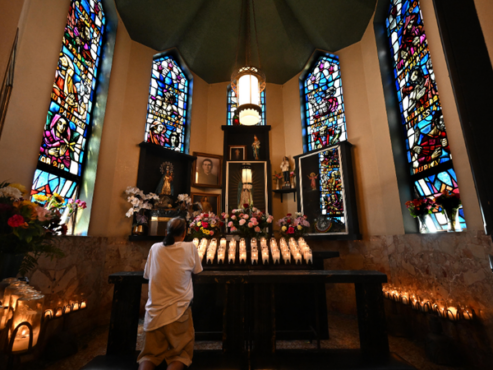
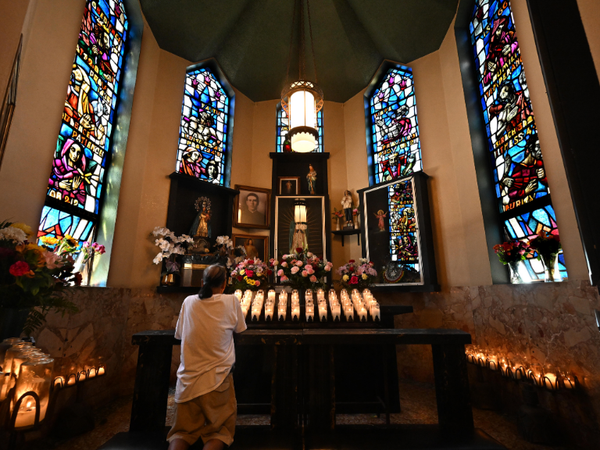
THE CANDLE ROOM IN ST. BONIFACE CATHOLIC CHURCH’S NARTHEX FEATURES STAINED GLASS WINDOWS WHERE THE FAITHFUL COME TO PRAY. PHOTOS BY STEVEN GEORGES/DIOCESE OF ORANGE
The seeds of St. Boniface first took root in the early 1800s, when the original Spanish families—the Yorbas, Peraltas and Rimpaus— met for Mass and sacraments in local homes. The city of Anaheim was founded by German immigrants in 1857, and by 1869, it was time to build a permanent church. St. Boniface was named in honor of the English-born Benedictine monk, saint and martyr who evangelized the raucous Germanic tribes of Eastern Europe.
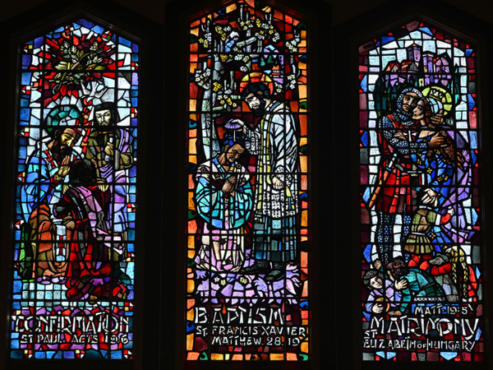
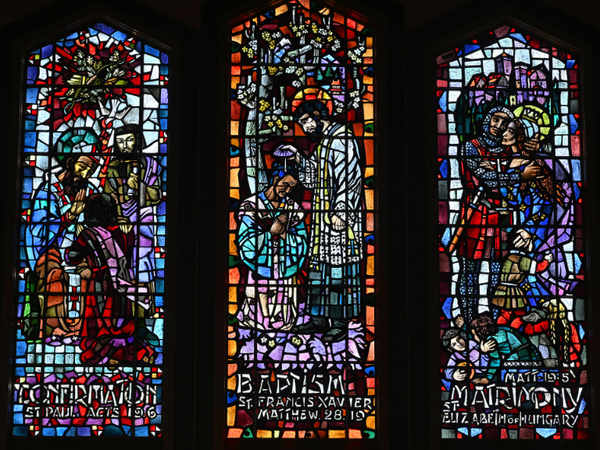
STAINED-GLASS WINDOWS DEPICTING THE SACRAMENTS OF CONFIRMATION, BAPTISM AND MATRIMONY LINE A WALL AT ST. BONIFACE CATHOLIC CHURCH.
By the late 1950s, the church had grown well beyond the small church established a century before, so under the leadership of the Belgian-born pastor, Fr. John Quatannens, the congregation built a cathedral-like church interior with elements of the spectacular Gothic cathedrals of Belgium and elsewhere in Europe, with an exterior that captured the mid-century modernist aesthetic of the day. The result is a church where the catechism is written in light and color.
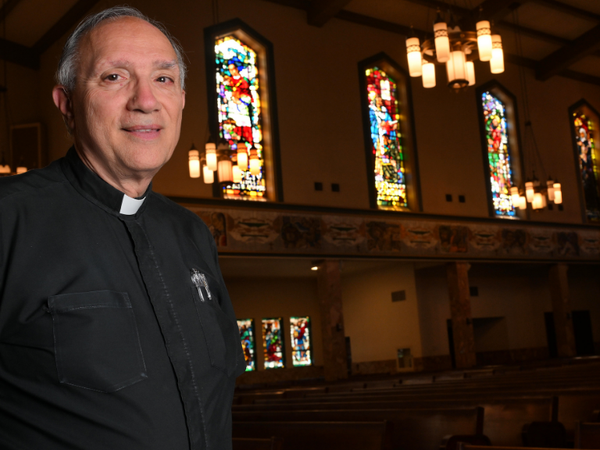
According to the pastor, Fr. Ed Poettgen, “Although the exterior of St. Boniface is decidedly mid-century—totally 1962— the interior feels far older, more in line with a European church from an earlier time. That is no accident. Fr. Quatannens intended to create something with cathedral-like dignity. While diocesan leadership required a more contemporary exterior, inside he realized his original vision: a space where light, color and symbol draw worshippers into mystery.”
Fr. Poettgen explained that the windows themselves were planned with unusual intentionality. Rather than a random assortment of favorite saints, the designer chose a structured program: the gifts of the Holy Spirit on one side and the Sacraments on the other. In this, the church returns to a medieval instinct—the building as catechism for the faithful, many of whom once could not read, but all of whom could “read” images.
Each window pairs a biblical text with an image of a saint, sometimes in ways that raise as many questions as they answer. For example, the window representing the Anointing of the Sick cites the Letter of James: “Is there any sick among you? Let them call upon the priests…”
Theologically, this text belongs to James the Less, patron of the sick, yet the figure in the window appears to be James the Greater, the apostle of Compostela, patron of pilgrims, Spain and people suffering from arthritis. The apparent mismatch has become part of the local lore: a reminder that iconography is as human and fallible as it is beautiful and inspired.
Similarly, the window for Matrimony depicts St. Elizabeth of Hungary. She was married, widowed young and then lived a life marked more by asceticism and radical charity than domestic stability.
Fr. Ed observed, “If you were choosing a couple to embody Christian marriage today, you might reach instead for Saints Louis and Zélie Martin, the parents of Thérèse of Lisieux who were canonized as patrons of married couples. Yet Elizabeth’s presence links the vocation of marriage to sacrificial love for the poor, suggesting that Christian family life, too, is ordered outward in charity.”
Other choices reflect the missionary horizons of the Church. The Baptism window does not show Christ in the Jordan, but St. Francis Xavier, apostle to Asia who baptized thousands into the faith; Confirmation is represented not by a classic Pentecost scene but by St. Paul in Acts, underscoring the Spirit’s power to drive mission outward. These decisions mirror the theological currents of the pre- and post-conciliar era, when the Church was reimagining herself less as a fortress and more as a people sent. Like the teaching role of medieval churches that were built to teach theological truths to mostly illiterate people before printed Bibles were widely available, St. Boniface invites more than just artistic appreciation; it calls the viewer to think about what is being represented, meditate on the Scripture verse in each window while witnessing how the Church, through the actions of saints, has lived out biblical teaching over the centuries.
Visitors often remark on the intensity of the colors and the way the windows instantly “make it feel like a church.”
In an age when many Catholics—and especially younger ones—are seeking a renewed sense of the sacred, St. Boniface’s stained glass quietly offers what the best church art has always promised: a glimpse of heaven, rendered in the language of earth.
A description of each window is available on the St. Boniface website at stbonifaceonline.org.