
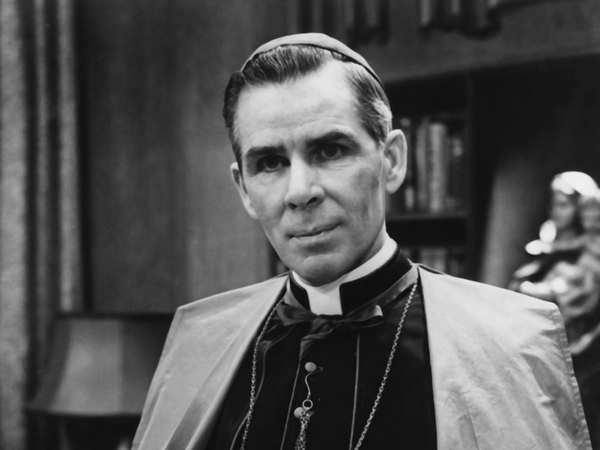
ON SEPT. 24, the Catholic Church will raise to the altars a man who many older Americans remember from radio and television: Archbishop Fulton J. Sheen. Because of his involvement in the Mission Church and his connection to the Diocese of Orange, I offer you this article about the man we will call Blessed Fulton.
Born to an Irish-descended family in El Paso, Illinois, on May 8, 1895, Sheen discerned his call to the priesthood and went to the seminary in St. Paul, Minnesota. He was ordained for the Diocese of Peoria on Sept. 20, 1919 — note his beatification is close to the anniversary of his ordination.
After extensive further studies in Europe, he returned to the U.S. and taught at Catholic University of America in Washington, D.C., 1926-1950. He was ordained as an auxiliary bishop for New York in 1951. In 1966 he was the Bishop of the Diocese of Rochester, N.Y., until 1969. St. Pope Paul VI named him an Archbishop in 1969, which is the title he kept to his death.
While he was a teacher, he began participating in a Sunday evening radio program called “The Catholic Hour” on NBC (1930-1950). As a bishop he moved to television in 1952 on Tuesday evenings where he aired opposite Milton Berle’s comedy show. “Life is Worth Living” was a huge success, winning Sheen an Emmy Award in 1953 and was watched by as many as 30 million viewers each week, mostly non-Catholics. Some claim it was the most widely viewed religious series in the history of television! His preaching and teaching made him one of the earliest “televangelists.”
His show lasted until 1957. He returned to television in 1961 with “The Fulton Sheen Program” which ran until 1968, during which he was also the Bishop of Rochester. In 1950, Sheen was appointed the national director of the Society for the Propagation of the Faith, ending his teaching post at Catholic University but continuing his “Life is Worth Living” program. He moved to New York City where the Mission Office was located and where the TV show was taped near St. Agnes Church in Midtown Manhattan. Sheen took advantage of his many speaking engagements and television presence to advocate for the Mission Church to the point that fully two-thirds of all funds raised worldwide came from the United States. At the height of his fundraising efforts more than 10,000 letters with donations arrived at the national office every day. Sheen created a mission rosary so people could intentionally pray for missionaries and those they served around the world: different colored beads representing each of the five continents.
He also improved Mission Magazine, making it more engaging and visually appealing, which also improved the way the Church communicated the mission message. It was this early success as mission director that helped lead to his appointment as a bishop, adding more weight to his message to serve the Church’s central purpose — to spread the Good News. He personally supported the missions with the proceeds of his television programs, and many of his books are still generating income for the Pontifical Mission Society to this day.
Sheen wrote 73 books and articles, many of his talks were recorded and copied for worldwide production on cassette tape, and he was a sought-after speaker until his health declined in the late 70s. His TV programs are still rerun on EWTN and Trinity Broadcasting.
In 1979, Time magazine posthumously labeled him “God’s microphone” for his incredible effectiveness in reaching people in all forms of media available in his time.
Archbishop Sheen died on Dec. 9, 1979, at the age of 84 and was buried at St. Patrick’s Cathedral in New York City. After some controversy, Sheen’s remains were moved to St. Mary’s Cathedral in the Diocese of Peoria. His beatification was approved after a miracle was obtained in 2019 through Sheen’s intercession for a stillborn baby who after an hour was about to be declared dead and suddenly was (and still is) alive. His feast day will be Dec. 9, the anniversary of his death — it may compete with St. Juan Diego, the visionary of Our Lady of Guadalupe, but I expect Sheen would defer to Mary whom he loved and served as her priest.
In honor of soon-to-be Blessed Fulton Sheen, I invite you to do a few things: Pray the mission rosary once a week. Give to the missions as often as you are asked, especially this year’s World Mission Sunday collection Oct. 17-18. Read one of Sheen’s books (personally I like his Life of Christ, Seven Last Words, and Treasure in Clay, his autobiography)
Pray for his intercession that he may advance to sainthood.
An interesting fact: Rev. Robert Schuller, the founder of Garden Grove Community Church and later Crystal Cathedral Ministries, claims that it was Fulton Sheen who inspired him to use mass media to evangelize. His weekly “Hour of Power” Sunday television program, broadcast live from Garden Grove Community Church (which we now call the Arboretum) and later from the Crystal Cathedral (which we now call Christ Cathedral), showed the power of the spoken word using the best medium of the time — television broadcasting.
Dr. Schuller invited Sheen to the Garden Grove Community Church in March 1972 as a guest on his “Hour of Power” show where he spoke to an overflow crowd sitting in church and outside in cars. Fulton Sheen, pray for us! Pray for the Mission Church!