
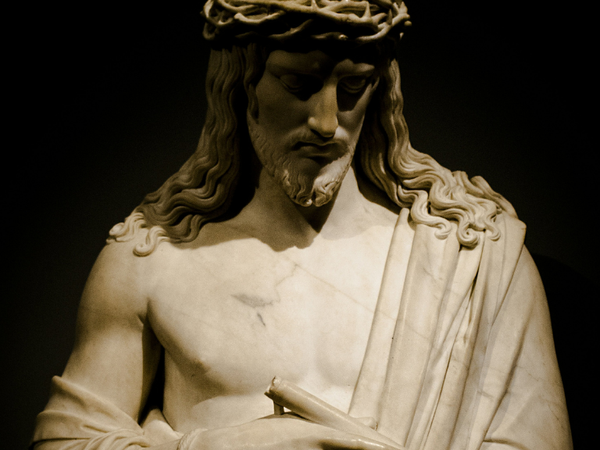
TODAY’S GOSPEL (Mt. 10:37-42) follows Jesus’ startling statement: “Do not think that I have come to bring peace to the earth; I have not come to bring peace, but a sword (Mt. 10:34).” The English theologian G.K. Chesterton observed that Christianity rejoices in the separation that set souls free—the sword of Christ that cuts through illusion and demands a choice.
Years ago, an attorney at my firm would begin difficult discussions with a paradoxical warning: “I love you like a brother, but I am going to have to run a sword through you.” It was his way of saying that compromise was not possible.
Jesus speaks with similar directness in today’s Gospel. These are not comforting words. They are demanding and uncompromising. This passage is often called part of a “missionary handbook,” a description of what discipleship requires. We may wonder whether Jesus is setting a high standard only expecting to be met halfway. But Jesus leaves no room for negotiation. Whoever loves father, mother, son or daughter more than Jesus is not worthy of Him. Then He goes further: take up your cross, lose your life and follow me. Jesus emphasizes discipleship requires choosing Him above all else, without exception; and if just lukewarm, He will spit us out (Rev. 3:16). As the poet T.S. Eliot wrote, “Christianity is a condition of complete simplicity, costing not less than everything.”
Bishop Robert Barron illustrates this priority through the story of St. Thomas More. When King Henry VIII demanded approval of his unlawful marriage and claimed authority over the Church in England, More refused. He lost his position, freedom and ultimately his life. His final words captured the essence of discipleship: “I die the King’s good servant, but God’s first.”
Initially, Jesus’ demands seem harsh. Yet He is not telling us to stop loving our families or reject the good things of life. Rather, He teaches it is only by loving God first—the source of all love—that we can truly love others.
This is the paradox of the Gospel: losing is finding; dying is living; weakness becomes strength (Mt. 10:39; Jn. 12:23-25; 2 Cor. 12:10). By surrendering our egos to Christ, we discover the life we were created to live. Jesus asks for sacrifice not because He needs anything from us, but because He desires our fulfillment. Jesus offers the greatest possible good- eternal communion with God—which requires the greatest possible commitment. Choosing Christ will often create division. Some relationships, ambitions and values will oppose the Gospel. Jesus warns not everyone will choose Him, and those who do will experience conflict with those who don’t. Yet the reward far exceeds the cost. He offers nothing less than eternal happiness. Jesus concludes by making discipleship practical: receive the prophets among you, offer a cup of cold water and do these things because “he is a disciple (Mt. 10:42).” We are called to be Christians, imitators of Jesus, not secular humanists whose good deeds are devoid of divine connection. We are to do the good for “my [Jesus’] sake (Mk. 10:29),” a personal commitment to him, not an abstract goodness separated from God.
So we must ask ourselves: Has God remained our highest priority? Or have possessions, technology and distractions taken His place? As commentator Peter Kreeft reasoned, the more we disconnect ourselves from the source of truth, life and love, the more we lose ourselves and experience the futility of trying to be “god” to each other. The “sword” of the Gospel separates what is passing from what is eternal so that we may choose what truly matters. If you want Jesus to claim you, then you must claim Him. Following Christ is not losing—it is winning. It is not death—it is life. It is not something—it is everything.