
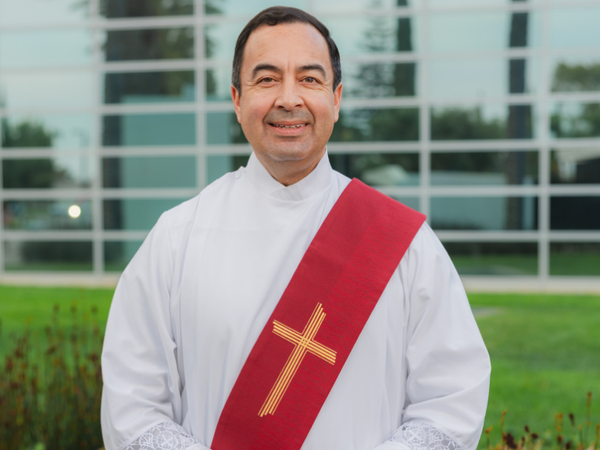
DEACON TOM SAENZ didn’t enter the Diocese of Orange’s permanent diaconate, expecting to one day lead it.
“I thought I’d be working with the poor,” he said. “That’s what really attracted me.”
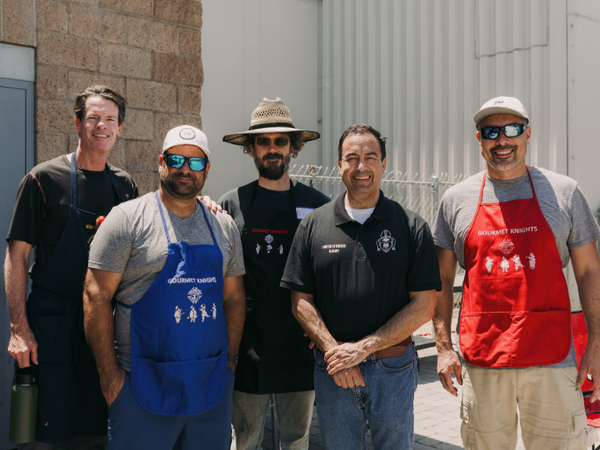
DEACON TOM SAENZ IS PICTURED DURING A 2025 DIACONATE FOOD DISTRIBUTION EVENT. PHOTOS BY IAN TRAN/DIOCESE OF ORANGE
However, even before he was ordained, he was approached by Deacon Frank Chavez to consider succeeding him as director of the Office of the Permanent Diaconate. The suggestion surprised many within the diaconate — including Saenz himself.
“It was a complete surprise,” Deacon Tom said. “And the surprises never end.”
The outgoing director, who had served as a deacon for 37 years and led the office for 20, was retiring and saw a leader in Saenz.
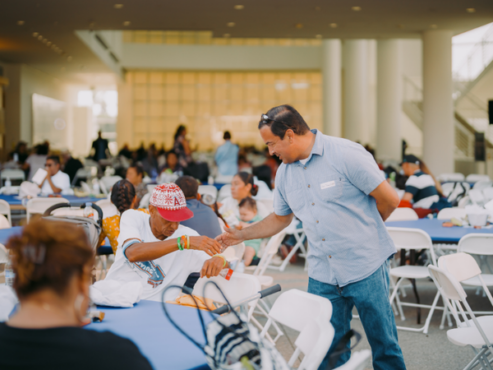
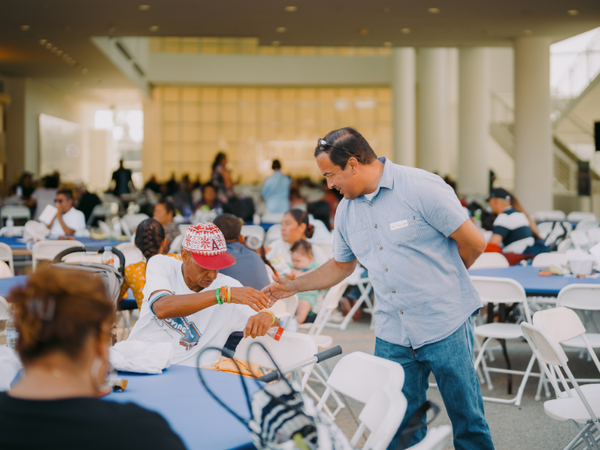
DEACON TOM SAENZ GREETS A GUEST DURING THE ANNUAL TREASURE OF THE CHURCH DINNER HELD ON AUG. 12, 2023. THE FREE EVENT OFFERS FOOD, MUSIC, FELLOWSHIP AND ASSISTANCE TO THOSE FACING FOOD INSECURITY, HOMELESSNESS OR HARDSHIP.
What Deacon Tom lacked in diaconate experience, he made up in other ways important in modern organizations and management. Overseeing a group of 138 active deacons, and growing, with another 45 currently in formation, requires a particular skill set. Deacon Tom is bilingual, has an MBA from Chapman University and the requisite technology background. He was the owner-operator of a successful business with 17 years’ experience. His work included guiding professionals through continuing education, which is a key part of diaconal formation.
Plus, as Deacon Frank said at the time, “He has a beautiful spiritual life.”
Currently, the diocese is seeking and accepting applications from candidates and their priests for the Class of 2032.
Applications will be accepted until July 1.
LEADING THE MINISTRY
Now four-and-a-half years into his tenure, Deacon Tom, 54, sees God’s providence in the decision made by the retiring director.
“The Church saw I had different gifts to give,” Deacon Tom said.
Since taking over leadership of the office, Deacon Tom has modernized the diaconate’s website and updated the formation curriculum, including the addition of an online academic component developed in collaboration with the Pontifical College Josephinum in Ohio. Formation now spans nearly six years, beginning with a six-month discernment period followed by five years of formal preparation before ordination. And those are just formal requirements. As Deacon Tom said, the growth never stops.
Aspirants, candidates and deacons are always expanding their knowledge and spiritual growth in Scripture study, homiletics, spirituality and liturgy, provided and supported by the diaconate. Technology, communications and other aspects notwithstanding, much of the work of deacons remains rooted in the early days of the Church. The term deacon originates from the Greek word diakonos, meaning “servant.” The ministry appears in the Acts of the Apostles, when seven men appointed to manage distribution of food to widows. Although diaconates and permanent diaconate faded over the years, they were revived during the Second Vatican Council and have become a vibrant and growing part of church life.
WHO ARE DEACONS?
“People see us at Mass and think that’s all we do,” Deacon Tom said of himself and his fellow deacons, who assist during liturgies by proclaiming the Gospel, preaching, distributing Communion and supporting the celebrant.
Deacon Tom describes the ministry in three dimensions:
The Word — teaching and proclaiming the word of God to make disciples.
Liturgy — participating in Mass and church services, including baptisms, marriages and first Communions.
Charity — going outside the walls of the church in service to the public.
A fourth, informal yet key part of the diaconate, is wives and families, according to Deacon Tom, who has been married to Bianca for 28 years with three adult daughters. Wives are essential to the diaconate, often referred to as a blessing, heart or backbone of the ministry and seen as part of a shared vocation. Throughout formation and beyond, wives participate alongside their husbands and become active parts of the community of permanent deacons.
In many ways, deacons are the living bridge between the church and community.
“We have one foot in the modern world and one foot in the Church, shared Deacon Tom. “We are that witness.”
As part of their outreach, Orange County deacons participated in more than 1,800 feedings, 2,600 visits to the shut-ins, 640 hospital visits and 280 jail visits. They were part of more than 5,300 baptisms, 2,700 funerals, 558 sacramental marriages and 265 quinceañeras. They were involved in between hundreds to thousands of marriage preparation, faith formation, baptism preparation and bible study sessions and classes. On average, deacons donate about 17 hours a week in service of the church.
And that is in addition to their visible in-Mass participation. Pope Francis called deacons “the guardians of service in the Church.”
“Being a deacon,” Deacon Tom said, is all about “helping others find God’s plan in their lives – that’s the diaconate.”
ARE YOU CALLED TO SERVE?
According to Deacon Tom, the most important aspect to becoming a deacon is to be “called,” and begin a personal discernment. Beyond that, applicants must be:
■ Formally presented for the diaconate by a pastor who will help mentor during formation.
■ Committed to and living out Gospel values with demonstrated leadership qualities in parish/diocesan ministry for the past five years.
■ Between 30 and 55 years old; Married in a stable, supportive marriage/family for at least seven years or, if not married, willing to commit to celibacy.
■ Capable of giving serious time to theological study, spiritual formation and ministry.
■ A high school graduate or GED holder.
To learn more, visit www.rcbo.org/ministry/diaconate/ or contact Liliana Pinon, program manager, Office of the Permanent Diaconate at (714) 282-3035, [email protected]