
WITH FAMILY gathering together for the holidays and a little time off on the calendar, there’s another reason to make the drive to Los Angeles: a new exhibition at the Getty Museum that’s well worth the trip.
The Holy Family at Home exhibition on display through Jan. 10, celebrates the portrayal of the Holy Family as a loving trio, a fresh view adopted by Northern European artists around 1500.
OC Catholic recently spoke to the exhibit’s curator, Dr. Anne Woollett, and Dr. Elizabeth Morrison, Senior Curator of Manuscripts at the Getty Museum.
Editor’s Note: Answers may be edited for length and clarity.
1. What inspired the Getty to organize an exhibition around the theme of The Holy Family at Home, and why is this an important subject to explore through art?
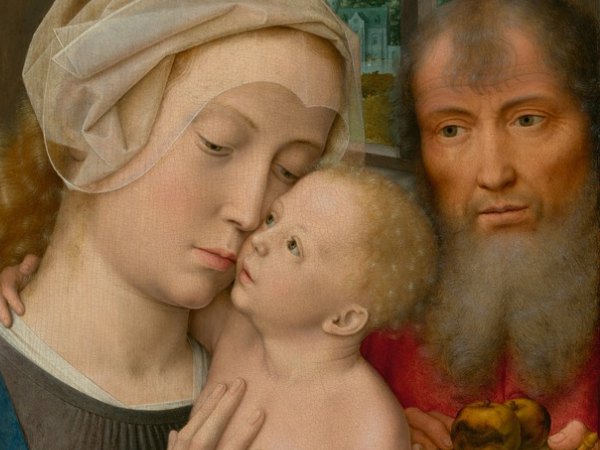
We organized the exhibition primarily to highlight an exciting new addition to the Getty Museum’s collection. Gerard David’s Holy Family (ca. 1520), acquired in 2023, represents a rare devotional painting by one of the leading artists of the period. David’s tender portrayal of the Virgin and Christ Child, and the prominent presence of Joseph, is not only very appealing scene, but also a specific interpretation of the theme as an intimate human exchange set in a contemporary domestic interior. We thought it would be fascinating to present David’s painting in an iconographic and formal context to convey the significance of its imagery in the early 16th-century, when the depiction in panel paintings and manuscript illuminations of St. Joseph taking an active role in the raising of Jesus was a relatively new perspective in art. The Holy Family at Home, which can be enjoyed both as a purely visual experience and through the labels and wall texts in the gallery, provides an approachable introduction to devotional practice and culture in the Netherlands.
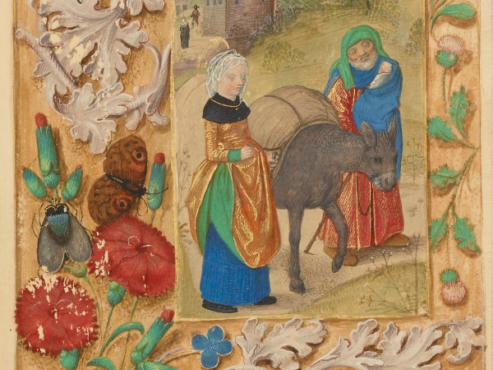
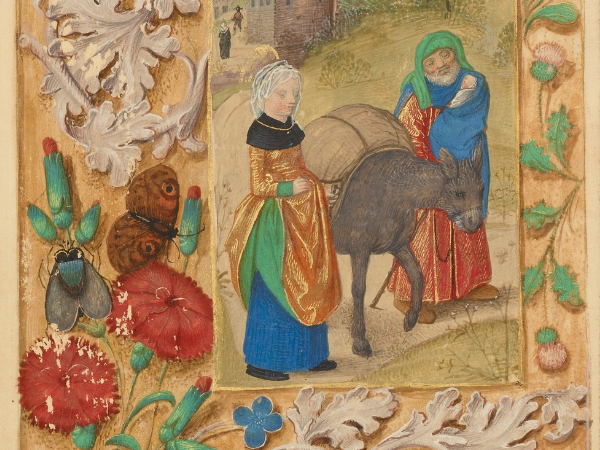
“THE FLIGHT INTO EGYPT”ABOUT 1480– 85 FROM CROHIN-LA FONTAINE HOURS MASTER OF THE DRESDEN PRAYER BOOK OR WORKSHOP (FLEMISH, ACTIVE ABOUT 1480– 1515). GETTY MUSEUM
Although the Holy Family is a central theme in art and may be familiar to some viewers, others may not be conversant with the subject and modes of interpretation, so the exhibition brings together panel paintings and illuminated manuscripts from around the same period as David’s work that depict this family unit as a key aspect of Christian thought and experience. The exhibition identifies two primary approaches to representing the Holy Family with St. Joseph – the conventional characterization of Joseph an elderly husband and father who was close to, but separate from, the Virgin and Christ Child, and Joseph as a hands-on Dad – and some of the domestic narratives that were meaningful around 1500.
Through this approach we hope to enable viewers to recognize the different narratives within the theme, and perhaps even find that not all paintings of the Holy Family are the same!
2. The exhibition highlights a shift around 1500 toward portraying Jesus, Mary and Joseph as a more intimate family unit. What influenced this change in how artists depicted the Holy Family?
There are many factors that contributed to the depiction of the Holy Family in a domestic interior in the Netherlands. They include theological treatises, notably the work of the French theologian Jean Gerson (1363 – 1429), who wrote a biography of St. Joseph, publications by later religious groups, and sermons in the Netherlands and France. Ideas about the Holy Family’s activities at home also were articulated visually, and the exhibition shows this with panel paintings and manuscript illuminations.
3. What makes Gerard David’s The Holy Family particularly significant, and what details should visitors look for when viewing this painting?
This is a late work by David (ca. 1455–1523), and visitors to the exhibition will note how large the figures are and their proximity to the viewer, a strategy David employed to enhance the sense of immediacy. This painting embodies David’s signature command of color, delicate brushwork and most importantly, the compassion that are the hallmarks of his devotional subjects. The wonderful condition of the Holy Family preserves David’s characteristic subtle modeling of flesh, as well exquisite details such as the fine gold highlights of the Virgin’s tresses, and the tiny swan on the pond in the background. The Virgin’s fingers press gently into Christ’s soft flesh, and the two apples resting on the lid of the wooden bowl held by Joseph present a remarkable still life.
4. Many of the works emphasize the tender, everyday interactions among Mary, Joseph and Jesus. What do these depictions reveal about how people of the late Middle Ages viewed family life, parenthood and the home?
People in this period were very interested in the quotidian activities of these holy figures, which made them relatable and human. This perspective was probably also shaped by the Devotio Moderna (Modern Devotion), the late medieval Christian reform movement which emphasized humility and identified the divine in everyday subjects.
5. Although these works were created more than 500 years ago, the Holy Family remains a familiar and meaningful subject today. What do you think accounts for the enduring appeal of these images, and what do you hope visitors take away from the exhibition?
The illuminations and panel paintings in the exhibition remain compelling today. They speak to the viewer through their intrinsic beauty and clear narratives that articulate recognizable family relationships and behaviors. We hope these rare works depicting family life will resonate with our visitors and that they will bring their own responses to them.
For more information and museum hours, visit www.getty.edu/