
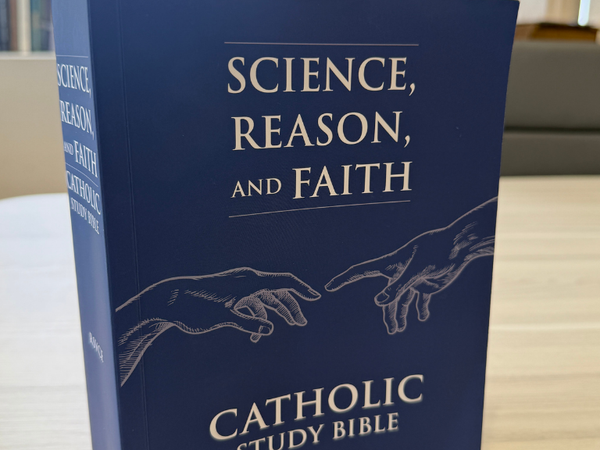
COMING IN AT 4 POUNDS and 2,059 pages, Fr. Robert Spitzer’s latest book is far from your average paperback.
He probably could use even more space considering his work addresses scientific, historical, philosophical and theological questions such as Why am I here? What do science and the Bible say? Can they be reconciled? Is Jesus historical and the Son of God? What Can Jesus tell me about where I am going? Why is there evil in the world? And What is the meaning of life?
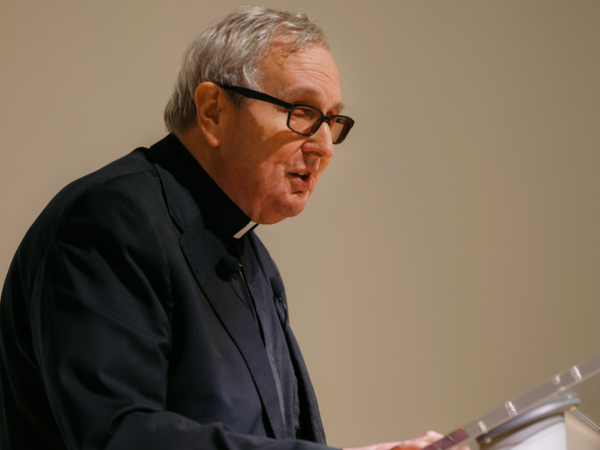
Fr. Spitzer, founder and president of the Magis Center of Reason and Faith, the nonprofit on the Christ Cathedral campus that is dedicated to developing educational materials on the complementarity of science, philosophy and faith, has been fascinated by that theme during his 43 years as a Jesuit priest. The latest work by the philosopher, educator, author, speaker and former president of Gonzaga University in Spokane, Wash., is believed to be the first study Bible of its kind to focus on that theme.
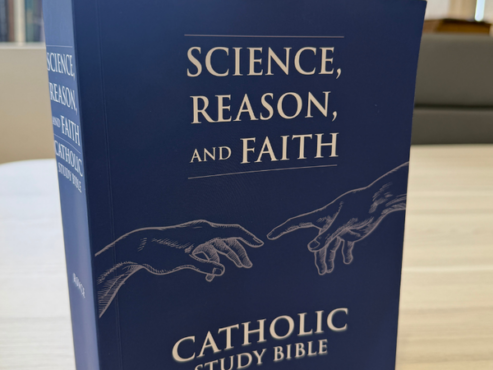
FR. ROBERT SPITZER’S LATEST BOOK IS TITLED, “SCIENCE, REASON, AND FAITH CATHOLIC STUDY BIBLE,” WAS PUBLISHED IN JULY. PHOTOS COURTEST OF FR. ROBERT SPITZER
TACKLING DIFFICULT QUESTIONS
“Science, Reason, and Faith Catholic Study Bible,” published in July, follows on the heels of Fr. Spitzer’s 2023 book, “Science, Reason, and Faith: Discovering the Bible.”
His new study Bible contains five introductory chapters to the Old Testament and four to the New Testament, with extensive notes in the margins of the Bible that expound on the seeming conflicts between science, reason and Catholic teaching.
By tackling difficult questions, Fr. Spitzer said, it is precisely through the integration of science, reason and faith that we can truly discover ourselves, our world and our God.
“If people get bored reading this study Bible,” he joked, “they can always use it for weightlifting.”
THE OLD TESTAMENT
In the five chapters leading up to the Old Testament, Fr. Spitzer addresses such topics as what the Catholic Church says about science and faith, whether the Old Testament is historical, what scientists and physicians say about God and religion, and the mainstream Catholic view of evolution.
“Catholics can believe in the theory of evolution so long as they do not deny the creation of a unique, trans-physical soul by God in every human being,” he wrote. “Our rational, self-conscious, transphysical soul is precisely what distinguishes us from all other animals…. We are animals capable of knowing and loving God. Only human beings are capable of religion.”
Fr. Spitzer noted that “Let there be light” in Genesis 1:3, which signals the first moment of creation, coincides remarkably well with the scientific account of creation.
God is moral, just, charitable and loving, Fr. Spitzer said.
So how do we square that with such stories in the Old Testament as Lot sleeping with his own daughters, Abraham trying to kill his son, even Jonah and the whale?
“We must consider historicity amid the development of moral doctrine in the Bible. Jonah and the Whale is a prophetic story, not history, and the story of Lot and his daughters and Abraham’s sacrifice, which are historical, must be understood in their cultural and historical context – the moral development of the patriarchal period which was a nomadic-warrior culture without the benefit of Mosaic and Christian revelation.
THE NEW TESTAMENT
The four chapters prior to the New Testament include such topics as how we can validate Jesus’ miracles, the historical evidence for Jesus’ passion and crucifixion and resurrection, what the Shroud of Turin tells us about the Passion of Jesus, and why we need a Church.
“The point of sacred Scripture is not to give an empirical-mathematical explanation of the physical universe (as science does) but rather to give sacred truths necessary for salvation,” Fr. Spitzer wrote. “If we respect the limits of each method and do not force Scripture to give scientific conclusions, or force science to give truths necessary for salvation, then contradictions fade away.”
God knows the longings of the human heart, Fr. Spitzer wrote, and he reveals himself to us through creation, through Scripture, and ultimately through the Incarnation.
“Christ helps us see that truth is not just the object of science and reason, but what animates the mysterious and loving power of faith,” he said.
Fr. Spitzer worked on “Science, Reason, and Faith Catholic Study Bible” for a year and a half. In addition to running the Magis Center, he is president of the Spitzer Center of Ethical Leadership, dedicated to helping Catholic and for-profit organizations develop leadership, constructive cultures and virtue ethics.
To purchase “Science, Reason, and Faith Catholic Study Bible,” visit Store.magiscenter.com