
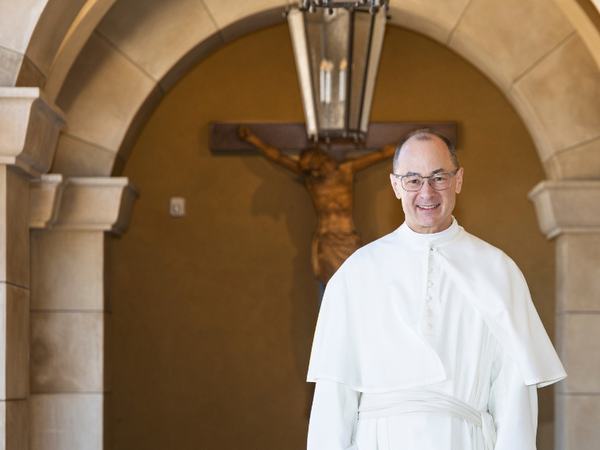
IN MANY WAYS, it’s the best time of the day. The surrounding wildlife can be heard retreating to their dens and lairs ahead of the sunrise; the roosters, chickens and songbirds stir to announce a new day; the fountain beneath the statue of St. Michael gurgles.
This is when Fr. John Henry Hanson, O. Praem, a Norbertine priest at St. Michael’s Abbey in Silverado, begins his prayer day.
“I like the early morning,” said Fr. John Henry, who is usually among the early arrivals for prayer. “All you hear are the animals.”
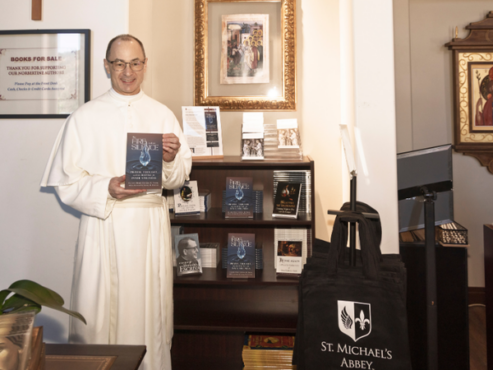
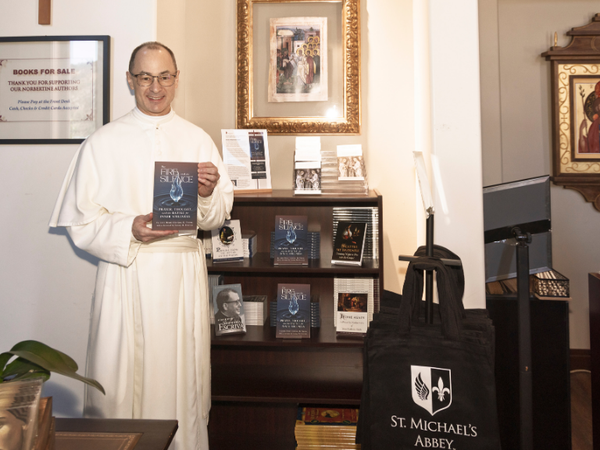
FR. JOHN HENRY HANSON, O. PRAEM., STANDS IN THE LOBBY OF ST. MICHAEL’S ABBEY HOLDING HIS LATEST BOOK, WITH OTHERS DISPLAYED IN A BOOKCASE. PHOTO BY ALAN WENDELL/DIOCESE OF ORANGE
The ambient sounds penetrate the hushed sanctuary providing a peaceful backdrop to the priest’s first communion of the day with God. By 5:45 a.m. the rest of the clergy members have filed into the sanctuary for the first of seven formal prayer times during the day. That is just what’s prescribed for official prayer. Throughout the day, in moments of quiet amid his active calendar, Fr. John Henry finds time for quick check-ins.
Prayer is foundational in Norbertine life. That makes a priest like Fr. John Henry particularly qualified to serve as a guide. He has a master’s degree in theology from the Pontifical University of St. Thomas Aquinas in Rome and an undergraduate degree in psychology from Cal. State Long Beach.
The Norbertine priest brings expertise to the fore in “The Fire and the Silence: Prayer, Thought, and the Battle for Interior Stillness.” His fifth book weaves together both religious and scientific underpinnings of prayer to explore the benefits of daily prayer, understand the roles of memory, imagination and a wandering mind within prayer, and helps guide readers to better understand prayer and find a closer, more meaningful relationship with the Almighty.
The goal, he said, is to “pray with greater peace.”
Fr. John Henry, whose first book was “Praying from Depths of the Psalms,” has given the subject plenty of reflection over the years and addressed it in countless homilies and writings. So, when Michael Aquilina, vice president of sales and marketing at Scepter Publishers, suggested “what to do with unwanted thoughts in prayer,” as a book topic, the priest was happy to take it on. As he said, it dovetailed with his interests and, “I didn’t have anything going.”
NO EASY TASK
In today’s world, various media encroach and vie for attention from all directions. There is the internet, hand- held tablets and screens, television and radio. There are even Bible chatbots and AI Jesus apps. And, of course, we are constantly busied by families, colleagues, work and daily activities. As a result, amid the rush and din, something as pure as an unadulterated, unintruded-upon talk with God is anything but simple.
In addition to the worldly encroachments, there is all the internal baggage we bring to prayer, such as the distractions of daily life, not to mention shame, self-sabotage, angst, doubt and a slew of other thoughts of restless and disordered minds. So, while the intent to focus on God is always admirable, most struggle with the follow-through.
Fr. John Henry’s book begins with an amusing excerpt from a Flannery O’Connor short story in which a little girl begins prayer earnestly enough, but invariably wanders into thinking about a dog, a girl or something else she was going to do that day. As the priest puts it, “A wandering mind cannot be avoided. It matters not that (thoughts) happen, but what you do with them. Be gentle in bringing it back to the Lord with intention.”
It takes time to settle into inner stillness, where one is able to be quiet, discerning, receptive in heart and mind and able to listen to and hear God. Like Carnegie Hall, the only way you get there is practice, practice, practice.
HOW TO GET THERE
Although his book is not a primer on prayer per se and more an examination of the contending aspects faced in reaching the proper state for prayer, Fr. John Henry has a couple suggestions for where to start.
First, find a space where prayer needs can be cultivated.
Naturally, Masses and churches and sacred spaces for scheduled Eucharistic adoration are ideal.
Fr. John Henry said, “the gold standard,” as expressed by the late Archbishop Fulton J. Sheen, would be a daily Eucharistic Holy Hour before the Blessed Sacrament. To the extent that is not possible, there are do-it-yourself next best things.
“You need to create a space that is sacred,” Fr. John Henry said. “An environment that’s quiet and allows stillness and absence of needless distractions.”
That means no phones, screens or communication devices. If you use written material, such as psalm or Bible passages in prayer, he suggests paper rather than electronic images.
Fr. John Henry said it is also important to establish patterns and routines for daily prayer. This helps precondition a person to prayer as a highlight of the day, “Start with 15 minutes, that is a good starting point,” Fr. John Henry said. He also suggests, “brief prayers throughout the day, even while driving or doing chores, to stay in the habit.”
NO SUCH THING AS PERFECTION
Finally, as the title of Fr. John Henry’s book suggests, there is an inherent tension in prayer between the fire of personal desires and silence. Although there is a “battle for inner stillness,” the effort needn’t be negative, particularly because of where it can lead.
“Persevere in prayer,” Fr. John said, “as the most important relationship in your life.”