

THANKSGIVING MAY NOT be a uniquely American holiday, as many other countries have festivals to celebrate harvests and such.
But for Catholics and Christians, Thanksgiving holds deeper and more profound roots beyond one-off holidays, celebrations and occasional days of service.
Giving thanks for God’s blessings is a core belief steeped in the Bible.
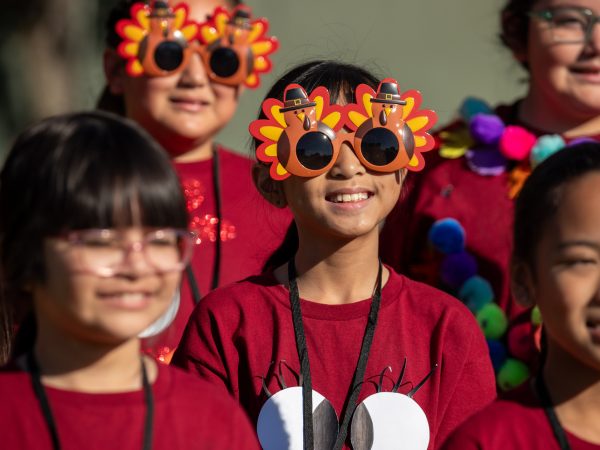
AVALYN DE LA PAZ, 10, A FOURTH-GRADE STUDENT, DONS TURKEY GLASSES DURING THE ST. PIUS TURKEY TROT AND JOGATHON FUNDRAISER ON NOV. 20 2024. PHOTO BY SCOTT SMELTZER/DIOCESE OF ORANGE
As Fr. Christopher Smith, rector emeritus of Christ Cathedral, explains, “gratitude is the basis of Christian life.” Fr. Christopher shared that the Thanksgiving holiday is “the day that we celebrate, but what makes it happen is an attitude of gratitude.”
BEYOND THE HOLIDAY
The day isn’t what matters, although family, feasts and football, not to mention feeding the poor, are all important aspects of the fourth Thursday in November. Thanksgiving isn’t a holy day of obligation. It isn’t associated with a saint. Furthermore, the original “American” Thanksgiving origin tales and claims are debatable.
The first Pilgrim Thanksgiving, to which the holiday is most connected, was celebrated in 1621 between late September and early November, and not at all the following year. The first event was based on the similar English and Wampanoag harvest festivals and traditions. It was a secular event with a three-day feast celebrating a successful harvest. Truth be told, Pilgrims and Puritans of the time were more likely to fast than feast.
The term “thanksgiving” was first used in writing in relation to the celebration in 1623, when gratitude was expressed for rains that saved their crops from drought. Although the Pilgrims’ claim to the original Thanksgiving may be a product of Northeast bias, these were the first such celebrations to continue annually.
Catholics can also lay claim to the inaugural Thanksgiving in America, when Spanish settlers and military landed near St. Augustine, Fla. in 1565, or another expeditionary landing in Texas in 1541, both in which priests purportedly conducted thanksgiving services.
There are also accounts of French Huguenots holding a service of thanksgiving in 1564 and Virginia and Maine have also claimed to host Thanksgiving in earlier years.
As a national holiday, Thanksgiving unfolded in steps from the Continental Congress to activist Sarah Josepha Hale and Abraham Lincoln, to Franklin Delano Roosevelt.
ABOUT A BELIEF, NOT A DATE
However, historical arguments overlook the notion of thanksgiving, which in Catholicism and Christianity is about something more basic than a day or date. In the Bible, even when thanksgiving isn’t explicit, as in Psalm 100 where we are instructed to, “Enter his gates with thanksgiving,” it is implicit.
As Fr. Christopher noted, “All of Jesus’ life is based on gratitude. He always preceded everything with a prayer of thanks.”
Fr. Damien Giap, O.Praem, school rector at St. John the Baptist School in Costa Mesa stated, Thanksgiving is really an everyday aspect of Catholic life.
“When we celebrate Mass, the word eucharistia in the Greek (and Latin) language literally means thanksgiving,” Fr. Damien noted. “So, we are constantly giving thanks as a universal Church, because Mass is offered up at every moment somewhere in the world.”
Fr. Timothy Peters, an assistant professor of biblical studies at St. John’s Seminary who leads the diocese’s Catholic Bible Institute, looks at King David maintaining gratitude both in victory and defeat as instructive.
“We can learn much from King David when it comes to Thanksgiving and giving thanks,” he responded in writing. “This is because David lived through excruciatingly difficult trials and was always able to give thanks to the Lord, even in the most difficult moments.”
Fr. Christopher likes to reflect on Colossians 3, particularly 12-17, which he says speaks beautifully on “dedicating yourself to thankfulness.”
Part of Colossians 3 reads: “Let the peace of Christ rule in your hearts, since as members of one body you were called to peace. And be thankful.”
And “whatever you do, whether in word or deed, do it all in the name of the Lord Jesus, giving thanks to God the Father through Him.”
Even when David lost everything and lived among Israel’s enemies, Fr. Tim wrote: “David was able to comprehend the Lord’s goodness and recognize that God has been gracious to him, and in this context, he composed Psalm 34.”
In the psalm, among other things, David offers thanks to God for his protection, saying “I will bless the Lord at all times; His praise shall be always in my mouth.”
According to Fr. Damien, the same should be true of Catholics, writing “we’re called to offer up every moment of the day to pray unceasingly.”
TAKING ACTION
Catholics are also compelled to express their gratitude through their deeds and actions. That is the second part of Thanksgiving celebrations, extending to Advent and beyond.
As Fr. Christopher said, if we were truly to take in and inhabit the notion of thanks, it would lead naturally to giving to others.
“Gratitude breeds generosity and we would have no choice but to want to share,” he said. “We wouldn’t have to do it one day, but we’d do it every day, and we’d talk about gratitude all the time.”