
CATHOLICS ARE accustomed to a variety of religious attire. Babies wear baptismal garments, altar servers and choir members have robes, religious orders wear distinctive habits, many communicants still wear veils, and, of course, there is the long-cherished Catholic school uniform.
During Mass and other sacraments, we witness clergy wearing a myriad of specialized clothing and accessories in several colors.
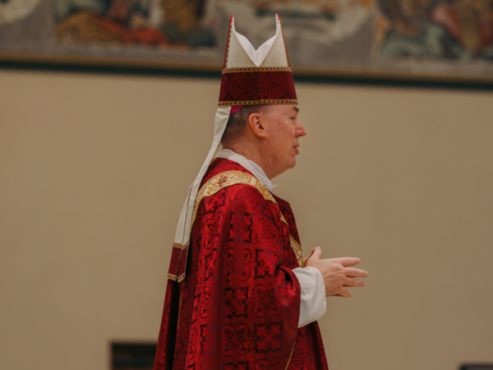
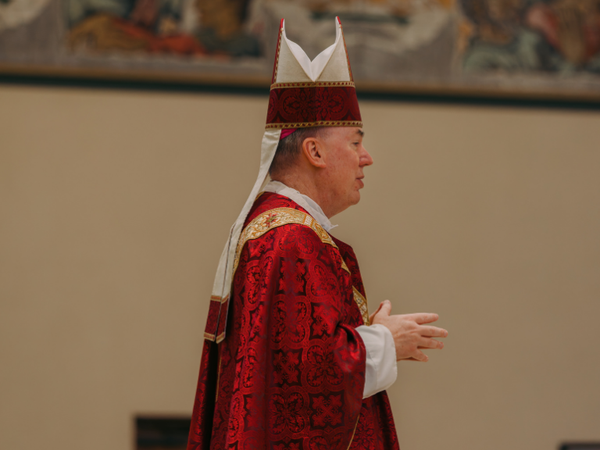
BISHOP TIMOTHY FREYER PRESIDES AT THE GOOD FRIDAY LITURGY ON APRIL 3, 2026, AT ST. BONIFACE CATHOLIC CHURCH IN ANAHEIM. HE WEARS RED, THE LITURGICAL COLOR TRADITIONALLY ASSOCIATED WITH GOOD FRIDAY. PHOTO BY IAN TRAN/DIOCESE OF ORANGE
In the early days of the Church, clergy wore the same clothing as ordinary citizens. And as secular clothing began to change in the fourth through sixth centuries, the Church retained these classical garments for religious rites and ceremonies. Gradually, over time, they took on deep theological and symbolic meanings.
Fr. Frederick Schmit, O.Praem., is a Norbertine priest who serves as sacristan at St. Michael’s Abbey in Silverado. In addition to his functions as sacristan, he has also been active in designing and making clerical vestments. He described the various components that a priest wears during the Eucharist and other sacraments.
“The amice is a white cloth that is worn around the shoulders and the neck,” he said.
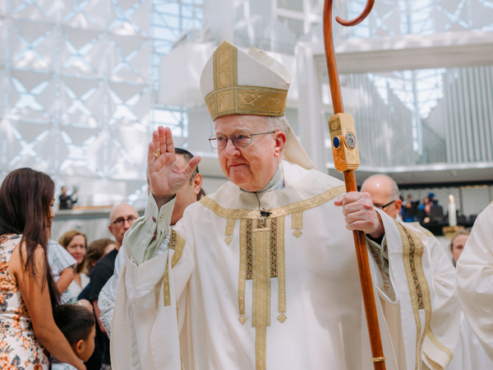
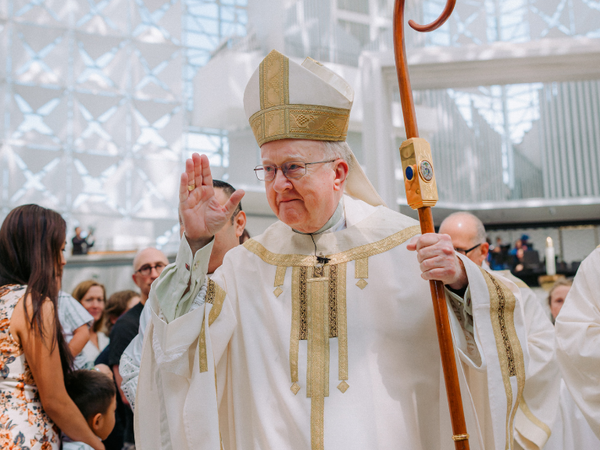
BISHOP KEVIN VANN IS PICTURED FOLLOWING EASTER SUNDAY MASS ON APRIL 5, 2026, AT CHRIST CATHEDRAL. HE IS WEARING WHITE AND GOLD, THE LITURGICAL COLORS THAT SYMBOLIZE JOY, PURITY AND GLORY. HE ALSO CARRIES A CROSIER, OR DECORATED STAFF. PHOTO BY IAN TRAN/DIOCESE OF ORANGE
The amice is considered the “helmet of salvation” and serves to cover ordinary street clothes so nothing non-liturgical shows.
Next is the alb, a full-length white linen robe that symbolizes purity of the soul and the grace of baptism. A cord tied around the waist called a cincture is used to secure the alb. It symbolizes chastity and self-discipline.
“The stole is the long piece of narrow cloth that goes over the neck,” Fr. Schmit said. “It is the primary symbol of priestly authority and the priest’s office.”
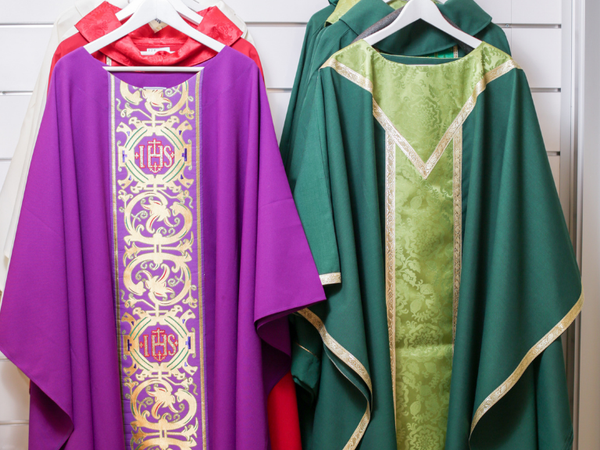
The one item that people see most immediately is the chasuble. This is the outermost liturgical vestment worn by a priest or bishop during Mass. It is worn over the alb and stole. The word is derived from a Latin word meaning “little house” since older versions of the chasuble covered the body like a small tent. The primary symbol of the chasuble is the “yoke of Christ.”
When the priest dons the chasuble, he may recite the following prayer:
“O Lord, who has said, ‘My yoke is sweet and My burden light,’ grant that I may so bear it as to obtain Thy grace.”
“The chasuble is put on last, representing the virtues of charity and love which must ‘cover’ all the others,” Fr. Schmit explained.
St. Paul even says this in his letter to the Corinthians:
“Of faith, hope and love, the greatest of these is love” (1 Corinthians 13:13).
Bishop Timothy Freyer highlighted the vestments that are unique to him and his fellow bishops, as well as archbishops, cardinals and even the Holy Father.
“First is the miter, perhaps the most recognizable of bishops’ wear,” Bishop Freyer said. “It is two tall, pointed halves in the shape of shields, the front one representing the Old Testament and the back one representing the New Testament.”
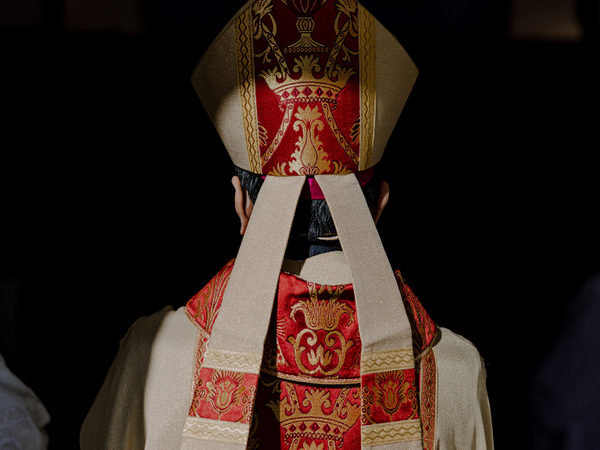
There are also two tassels called lappets, that hang on the back of a bishop’s miter.
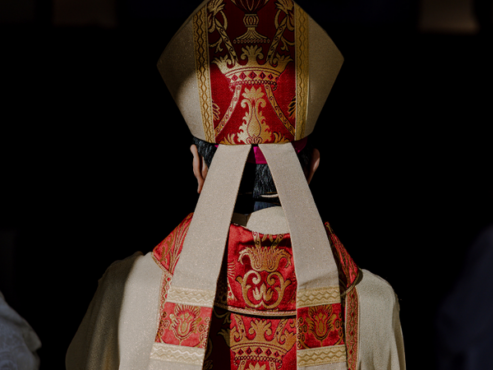
BISHOP THANH THAI NGUYEN WEARS A MITER, THE DISTINCTIVE HEADPIECE OF A BISHOP, WITH TWO TASSELS KNOWN AS LAPPETS HANGING FROM THE BACK. PHOTO BY KAYLEE TOOLE/DIOCESE OF ORANGE
“During the ordination rite, the Book of Gospels is held over the head of the man being ordained to remind him that we are always to be held faithful to the word of God,” added Bishop Freyer.
Then there is the crosier, or the staff shaped like a shepherd’s crook, a reminder that a bishop is the Good Shepherd and is tasked with bringing in all the lost sheep.
Additionally, bishops wear a ring on their right hand.
“We always wear the ring, and it serves as a reminder of the promise that we made to be faithful to Christ and to serve Him above everything else, to shepherd people with care, love and compassion and to be true teachers oft he faith,” said Bishop Freyer.
Deacon Modesto Cordero serves as the director of the Office for Worship for the Diocese of Orange. He explained: “A deacon normally wears the alb, cincture, stole and dalmatic. It is similar to a priest’s chasuble, a wide-sleeved outer garment worn by deacons and is often decorated with vertical stripes or bands called orphreys.”
Deacon Modesto added, “Although the current Roman Missal does not require a vesting prayer, the traditional prayer when putting on the dalmatic is, ‘Clothe me, O Lord, with the garment of salvation and the vesture of praise; and may this dalmatic ever be for me an adornment of glory.’”
The colors worn by clergy have specific meanings:
■ White and Gold: Symbolize joy, purity and glory. Worn during Christmas, Easter, weddings and feasts of non-martyr saints.
■ Green: Symbolizes hope, spiritual growth and new life. Worn during Ordinary Time (between Epiphany and Lent, and after Pentecost).
■ Purple or Violet: Symbolizes penance, preparation and sacrifice. Worn during Advent and Lent.
■ Red: Symbolizes fire, blood of martyrs and the Holy Spirit. Worn on Palm Sunday, Good Friday, Pentecost and feast days of martyrs and apostles.
■ Rose (Pink): Symbolizes a pause during a time of penance to rejoice in the coming celebration. Worn on Gaudete Sunday (third Sunday of Advent) and Laetare Sunday (fourth Sunday of Lent).
■ Black: Can be worn for funeral Masses and All Souls’ Day. Symbolizes mourning, death and prayers for the departed.
These vestments are not arbitrary or random. Instead, they all serve a specific purpose and function while acting in persona Christi, Latin for “in the person of Christ,” meaning that the priest, while celebrating Mass and the sacraments is acting not in his own power, but instead it is God and Christ who act through the priest.