
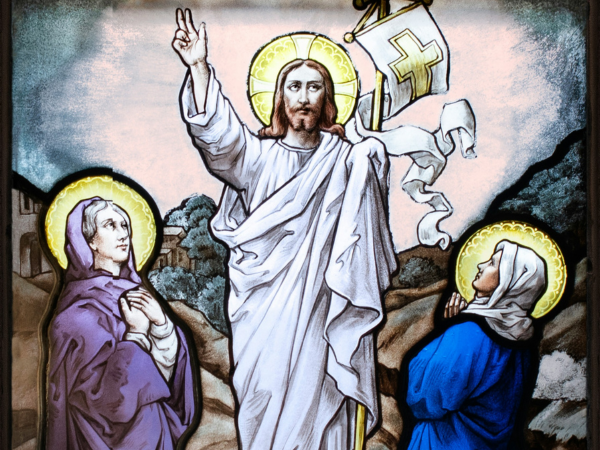
PARAPHRASING THE TITLE of an English novel by Christopher Monger, in the Transfiguration Gospel (Mt. 17:1-9), Peter, James and John go “up a hill but come down a mountain.” Bishop Robert Barron describes the Transfiguration as “the luminous transformation of Jesus that has dazzled mystics and inspired artists and poets throughout the centuries.” The Transfiguration remains mysterious, and the Church invites us not to solve it but to experience it in our hearts. Transfiguration is a two-sided coin: arguably the most glorious and the most terrifying event witnessed in human history. We cannot fully grasp either the beauty of God’s glory or the fear evoked by this supernatural encounter, because we were not there. And even if we had been, we would probably be like Peter, James and John—face down, overwhelmed, unable to rise without the consoling touch of Jesus, filled with awe, fear and questions.
St. Thomas Aquinas devotes an entire question in his Summa Theologiae to the Transfiguration. He explains that Christ revealed his glory to select apostles because those who undertake a difficult journey need to know where they are going. That hard walk is human life itself, marked by suffering, doubt, broken dreams, anxiety and loss. Without a glimpse of what lies ahead at the end of our striving “to enter through the narrow gate,” despair easily takes hold. The Transfiguration, occurring just before Jesus enters his Passion, strengthens the disciples—and us—to endure the darkness by unveiling the glory that awaits beyond it.
Aquinas reflects on the dazzling light that radiates from Jesus, attributing it to the qualities of the resurrected body, especially clarity—the capacity to shine. Holiness is associated with light because without light we cannot see what is beautiful, and in Christ’s light we see light (Ps. 36:10), that holiness resplendent beyond all.
Moses and Elijah appear with Jesus as witnesses to the Law and the Prophets. Moses the Lawgiver yields to Jesus, the Law made flesh; Elijah the messenger of God yields to Jesus, the Word incarnate. Together they echo John the Baptist’s humility: “He must increase; I must decrease.” They represent the Old Testament past, while Peter, James and John represent the new covenant future, the Gospel soon to be proclaimed. Together they model the Body of Christ, the Communion of Saints. In the Transfiguration, time converges just as it does at every Mass, where past, present and future are drawn into the saving mystery of the Cross and Resurrection.
Peter, James and John witness the Transfiguration not because of any hierarchy among the apostles, but because they loved the Lord deeply. Love, Aquinas concludes, is the requirement for truly seeing Jesus. Theologian Hans Urs von Balthasar reflected: “Getting [Jesus] is not so much a matter of clarity of mind as intensity of affection.” The Transfiguration reveals the goal of our journey, the promise of resurrection and the supernatural, beautiful light awaiting those who love the Lord.
There are two mountaintop experiences here. One is exhilarating, everything comes together perfectly, and like Peter we want the moment to last forever. But the second is more enduring: the fearful moment when the apostles cannot rise until they hear Jesus say, “Get up; do not be afraid.”
The words “get up” mean more than standing—they mean being raised up, the same language used in the Gospels for resurrection and healing. Jesus invites us to be raised up despite fear, live transfigured lives, listening to His voice amid many others and walking forward changed, with the light of Christ reflecting from us outward to others in darkness. Though fear and questions remain, love and light have the final word.