


“MONTESSORI” might be the current buzz word in parenting, but it is more than just wooden, aesthetic toys. A true Montessori education offers students self-directed learning.
But at one Garden Grove Catholic school, a Montessori preschool is offering students all that — and a chance to find the passion God gave them.
St. Columban Catholic School is the only preschool in the Diocese of Orange to offer its students a Montessori preschool experience while also building their Catholic identity.
“God has already created the child for something, and it’s not for us to fill them with all this knowledge, but to light the candle inside them so they can find what God has created for them,” said preschool director Portia Joseph.
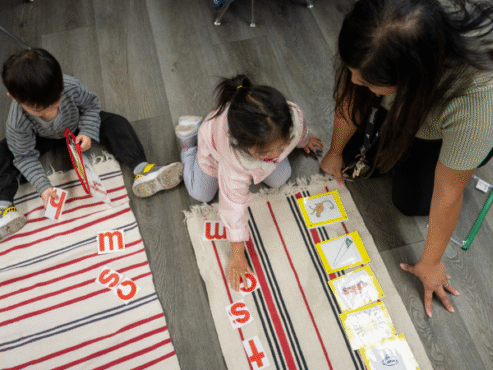
THERESA SOEWONO, RIGHT, HELPS KYLE TRAN, LEFT, AND ELYSIA NGUYEN DURING A PRESCHOOL CLASS AT ST. COLUMBAN CATHOLIC SCHOOL IN GARDEN GROVE. PHOTOS BY SCOTT SMELTZER/DIOCESE OF ORANGE
The Garden Grove school offers two full-day, multi-age preschool classes open to children ages 2 through 4 who are toilet trained.
“When I started working here, I was really impressed with how much the kids learn from the Montessori method and how advanced they can get,” said preschool teacher Cynthia Castillo. “I think it’s something they really enjoy and something they really learn from … it’s something I don’t see in other preschools.”
Principal Melissa Geary said students who come out of the program are well prepared for transitional kindergarten and kindergarten.

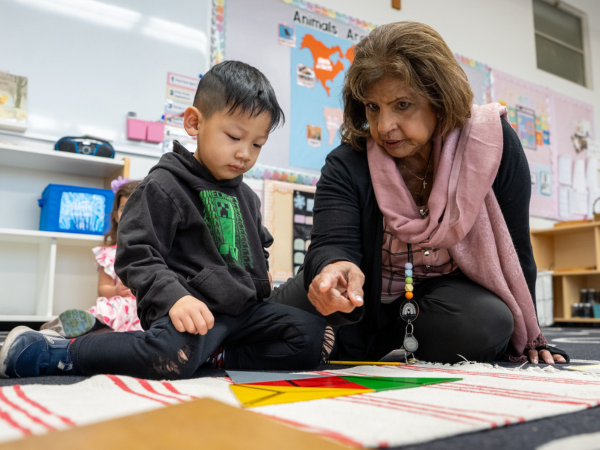
PORTIA JOSEPH, RIGHT, ASSISTS DONOVAN DOAN IDENTIFY SHAPES AT ST. COLUMBAN SCHOOL’S FIRST MONTESSORI PRESCHOOL PROGRAM.
“I feel like it’s a good fit, because we can really individualize the learning so we can cater to the kid’s needs,” Geary said.
Montessori is a pedagogical approach developed by Italian physician and educator Dr. Maria Montessori in 1907. It mirrors how children naturally learn, according to the American Montessori Society. Dr. Montessori, who was raised Catholic, designed her approach around four key principles: honoring the spirit and development of the whole child; children naturally want to learn; care of self, others and the environment; and equity, inclusion and social justice.
A veteran who ran her own school in Cerritos for 25 years, Joseph, who at 80 years old has no plans to retire, brought the Montessori approach to St. Columban in 2010. The preschool started with just 12 students, but within three months it had 45.
A typical day starts once students are signed into class. They give their parents a kiss or hug before heading in. Then they unpack their bags, independently put away their snacks and lunch, place their water bottle in a bin and pack away their bag before selecting an activity to work on. The classroom features the Montessori signature open shelves so students can choose their own work, set it up and clean it up independently.
“You are kind of letting them be,” Castillo said. “I think for a 2-and-a-half to 4-year-old, that’s rare to see.”
The classroom is set up by the five areas of study for early childhood: practical life, which focuses on daily activities that build fine motor skills; sensorial, which are activities that appeal to the five senses and encourage children to classify and create order; math with hands-on learning, such as using wooden sticks to practice counting; language; and cultural studies, which includes history, geography, science, art and music.
Later, students break into multi-age groups. One such group gathered around lead teacher Pamela Baca using colorful wooden shapes to explore how to build a triangle.
“OK, how do we check if we formed the triangle?” Baca quietly asked.
Next to them, 4 -year-old Owen worked independently to match pictures with the correct initial sound. Lining up “C” next to “corn,” “M” next to “moon” and “T” next to “top,” Owen flipped over the pictures to check his work before demonstrating his learning to Baca.
In the next room, Castillo led her students on geography.
“What’s next to Africa?” Castillo asked a student who was coloring her map of the seven continents before cutting and pasting photos of where different animals live.
“Yellow,” replied 4-year-old Thalia.
“But what’s it called?” prompted Castillo.
“Asia!” Thalia exclaimed.
Baca likes how the Montessori method allows children to work at their own pace. The multi-age classroom also allows the students to support each other in their learning, whether academic, social or in classroom routines.
“I feel like it works really well,” said Baca. “It’s not rushing the children to catch up to where they should be. It’s at their own pace until they master what they are learning.”
Hanh Nguyen, who has one daughter in the program and a son who has graduated from preschool, said she started researching the Montessori method before even having kids. She likes that the children are pushed to learn more when they show an interest in something and when they are advanced, their needs are still met.
“I love that they get to learn things at their level, at their pace, on their lead versus the traditional way of teaching preschoolers,” Nguyen said.