

At the time it was a curious artifact, known in certain religious and scientific circles, but nothing like the phenomenon it would become.
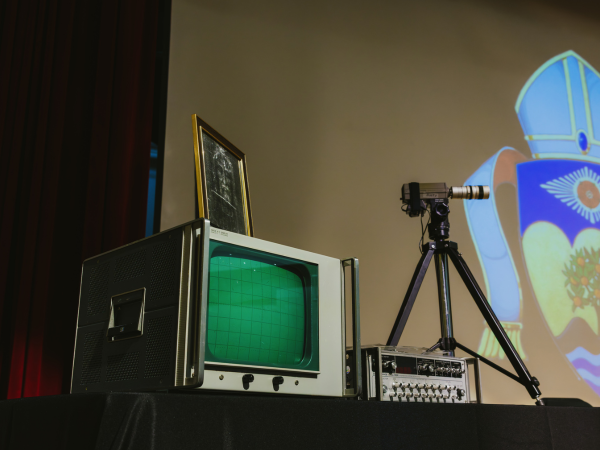
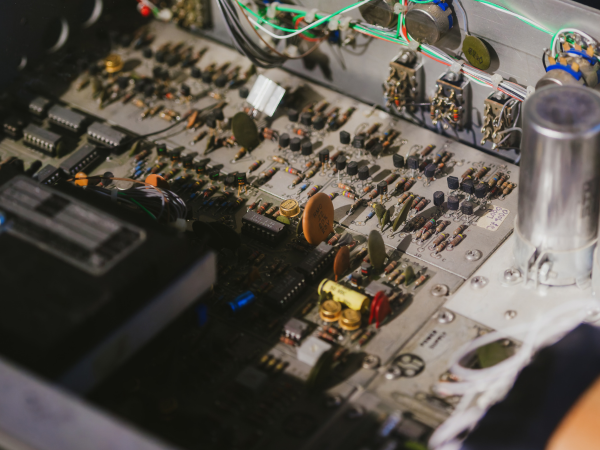
In 1976, Pete Schumacher was a 30-year-old fledgling product developer and engineer, living near Kansas City and working with a small company that made a device called the VP-8 Image Analyzer. An analog apparatus, it maps and graphs the brightness in various parts of a photograph of contoured surfaces. It was used for projects such as topographical mapping and x-rays.

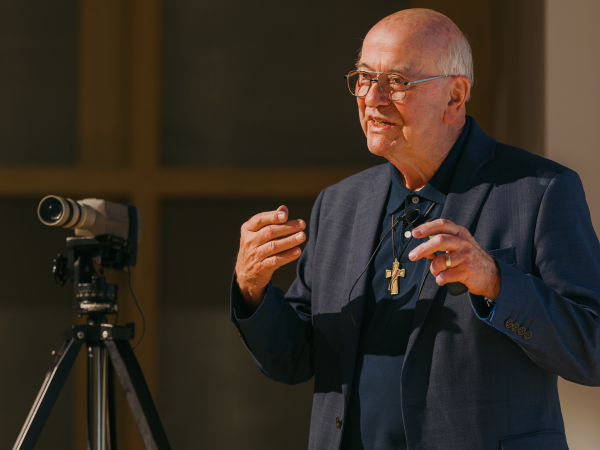
Attendees listen intently to Deacon Pete Schumacher during a speaking engagement hosted by “The Shroud of Turin: An Immersive Experience” on March 12.
One day, Schumacher was asked to take a road trip to Colorado to set up and demonstrate the VP-8 at the home of a U.S. Air Force Academy professor.
After completing the task, he was asked to scan a photograph to test the equipment.
What emerged felt all wrong. Indeed, it seemed impossible: an anatomically correct 3D image of a man, battered and bloodied.
That shouldn’t have happened. All other photographs of faces, paintings and other images studied since are distorted, with flattening of the reliefs and contours like noses.
To this day, how the perfectly detailed image emerged from that photograph remains a mystery. Schumacher has since conducted countless comparisons, studies and equipment calibrations.
“I can’t tell you why it comes out 3D,” he said.
On that fateful day in 1976, Schumacher was asked if he recognized the photograph with 3D properties. He didn’t.
“That’s the Shroud of Turin,” he was told. “I said, ‘That’s great,’” Schumacher recalled. “‘What’s that?’”
MAJOR BREAKTHROUGH
What it turned out to be was a monumental discovery — on a global scale for scientists and skeptics, the Catholic community and nonbelievers. On a personal level, it was transformational. It would lead Schumacher to become a permanent deacon with the Catholic Church, a prominent expert on the Shroud, and the founder of the world’s Shroud of Turin museums.
It also led him to become the inaugural speaker of a planned speaker series hosted by the “The Shroud of Turin: An Immersive Experience” museum on the Christ Cathedral campus in Garden Grove. To an interested crowd in the campus’ Freed Theater on March 12, Deacon Pete, as he’s known, spoke on his 3D discovery and much of his life’s work in his talk titled “The Shroud: What I Saw & How I See It.” He detailed both the historical journey of the Shroud through the ages, including the groundbreaking 1976 analysis, as well as his own personal journey.
Despite closely following Shroud developments, Schumacher’s life and faith path led him in different directions, including creating and selling several companies, marriage and studying for the diaconate.
In retirement, Schumacher’s Turin travels came full circle when he was offered 1,900 square feet of rent-free space in a mall in Alamogordo, New Mexico. It became his Shroud center, the nonprofit The Shroud Exhibit and Museum Inc.
Jon Storbeck, executive director of Christ Cathedral’s Shroud museum, said he hopes to continue hosting similar speakers and special events throughout the year.
“We’re all in the learning stage,” he said, adding that he was enthused by the initial reaction. “We’re still finding out what people want and what they’re looking for.”
AN OBJECT OF THOROUGH STUDY
In the years after Schumacher’s 1976 discovery, the Shroud of Turin would become a small cultural oddity to the world’s most studied artifact, having been closely examined by more than 100 different disciplines.
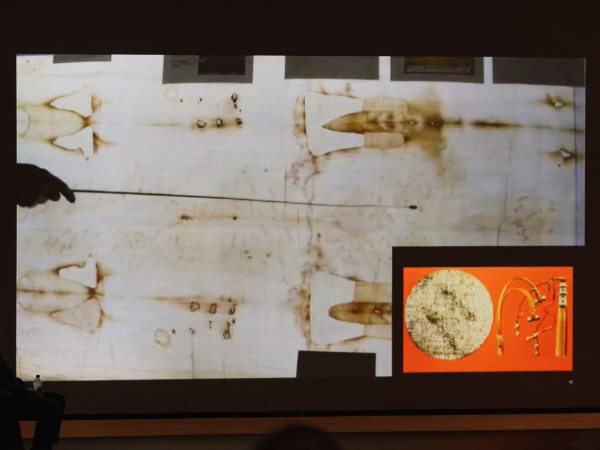
The Shroud of Turin is an approximately 14-foot linen burial cloth permanently housed in a climate-controlled case within the Chapel of the Holy Shroud in the Cathedral of St. John the Baptist in Turin, Italy, where it has been stored since 1578. Imprinted on the cloth, remarkably, is the image of a body with marks and blood stains that likely came from being tortured and crucified. The wounds closely resemble those described in the Bible of the Passion of Jesus Christ.
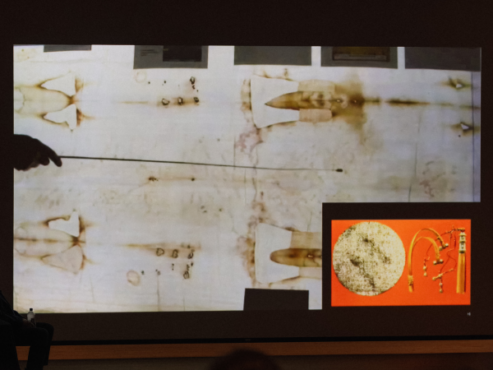
The Shroud of Turin has become one of the world’s most studied artifacts. Photos by Ian Tran/Diocese of Orange
To the faithful, the Shroud of Turin is undoubtedly the cloth once laid upon the Son of God. To others, it is an elaborate medieval hoax.
The Catholic Church has not officially acknowledged the Shroud of Turin as authentically tied to Jesus, but calls it a “mirror of the Gospel,” a profound object of veneration and a powerful icon.
Schumacher has studied the Shroud for the past 50 years, often having to defend his findings and technology. If you want to wind him up, ask something about the controversial carbon dating done on it — one which seemingly pointed to it being created in medieval times, not 2,000 years ago.
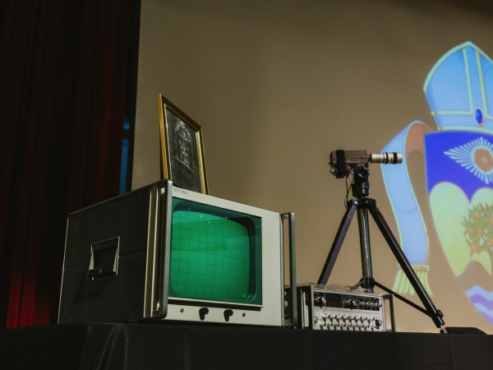
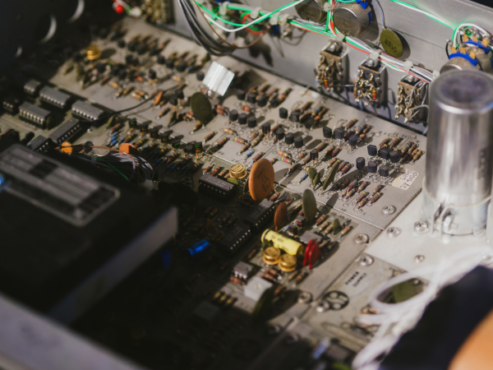
Deacon Pete Schumacher’s insights into the Shroud developed from the VP-8 Image Analyzer, which he produced.
For his part, Schumacher has no doubts about the Shroud’s authenticity and the fateful intersections it has had with his life and deepening faith.
As he put it, “When you see it, you must believe if you’re open and honest with yourself.”
Schumacher’s discovery in 1976 with his VP-8 Image Analyzer had a profound impact on future studies of the Shroud of Turin. Afterward, the Air Force scientists he worked with, Eric Jumper and John Jackson, helped launch the pivotal Shroud of Turin Research Project (STURP).
In 1978 with literally tons of scientific equipment, a large research team traveled to Turin and conducted what became the most extensive, hands-on study of the Shroud ever taken. Performing every imaginable spectroscopic, electrographic and related scientific measurement and experiment known at the time, the team spent five days of round-the-clock testing with the Shroud.
When National Geographic came out in 1980 with a 24-page spread on the cloth, complete with a four-page foldout, the Shroud of Turin officially went mainstream.
The image and the Shroud had an even more profound effect on Shumacher, who until 1976 had had an uneven path on his Catholic faith journey.
“There have been little things that started me pondering,” he said about his faith formation. “The big one was what we discovered at the house.”
For more information and for tickers to “The Shroud of Turin: An Immersive Experience” visit theshroudexperience.com/