
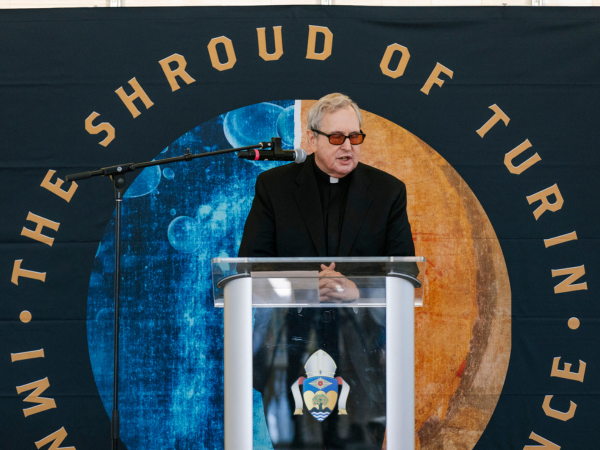
WHEN I WAS IN THE Jesuit novitiate at age 22, I happened upon a book in the novitiate library entitled, A Doctor at Calvary, by Pierre Barbet. He made an extensive medical investigation of the Shroud of Turin and described all the major events of Christ’s Passion by the blood and image evidence on the Shroud. I found the evidence so compelling and the description of our Lord’s passion so moving that I decided to investigate the Shroud more fully.
Between 1974 and 1988 (the time of the carbon-14 dating test), I accumulated a large amount of evidence of the Shroud’s authenticity as the burial cloth of Jesus Christ, most of which was discovered by the 1978 Shroud of Turin Research project (STURP) investigation. Two significant examples are:
■ The strong likelihood that the 130+ bloodstains are real human blood as manifest by AB blood type, human immunoglobulins, human hemoglobin, bilirubin and whole blood.
■ Dr. John Jackson’s compelling paper on the strong likelihood that collimated radiation from the body produced the highly unusual image on the Shroud. This image is the most unique image in history–it is a three-dimensional photographic negative image emblazoned on a non-photographically sensitive linen cloth. It has imaging in places where the cloth never touched the body, imaging from inside the body (e.g. the backbone), and it is intrinsic to the Shroud—not produced by any liquids (such as paints and dyes), vapors, rubs, powders or any other extrinsic substance. All of this points strongly to an intense burst of collimated radiation (which dead bodies do not naturally produce).
Then came the 1988 carbon dating, which dated the Shroud to between 1260 to 1390 A.D. Given the significant amount of data in favor of the Shroud’s authenticity and supernatural origin from the STURP investigation, I and other researchers were shocked. The three labs who performed the carbon dating had stellar reputations which led to an eight-year period where Shroud research was eclipsed by the obvious discontinuity between the 1978 STURP investigation and the 1988 carbon dating.
Research results began to change remarkably in favor of the Shroud in 1996. Three discoveries were particularly important:
I. Four new dating tests that date the Shroud to the mid-1st century A.D.—a wide angle x-ray scattering test (in 2022) which dated the Shroud to between 55 to 74 A.D. Additionally, a Fourier-transformed infrared spectroscopy, a Raman laser spectroscopy and a mechanical compressibility intention test, which when weighted yields a date of around 90 A.D.
II. Evidence from the pollen grains that shows the Shroud had to have been in Jerusalem and Northern Judea for several centuries.
III. The work of Tristan Casabianca, et al, and later Robert Rucker, indicating that the 1988 carbon dating had a glaring systematic error which was not (but should have been) reported in publication. This completely invalidated the 1988 C-14 dating test. The systematic dating error is very probably attributable to an intense burst of neutron radiation which is combined with N-14 in the linen cloth to produce a huge overabundance of C-14.
To make a very long story short, when the dating evidence was combined with the considerable evidence in favor of an intense burst of particle radiation producing the image and explaining all 46 enigmas on the Shroud, I moved from moderate to very strong conviction about the Shroud’s authenticity and the supernatural origin of its image.
To sum up what very likely happened, about 36 hours after the body was put in the Shroud, isotopes throughout the body began to fission (without a natural cause), giving rise to a low temperature nuclear reaction as well nuclear decay. This had four major effects:
■ A strong fluence of protons, deuterons and alpha particles that produced the image on the uppermost surface of the Shroud.
■ A strong fluence of neutrons that explains the bright red color of the blood,\ the strong carbonyl bonds in the linen and the superabundance of C-14 that caused the C-14 dating error.
■ Considerable radiation pressure which built up underneath the bloodstains, causing the bloodstains to be perfectly transferred (with retraction halos and edges) from the skin onto the Shroud.
■ The body had to disappear from inside the Shroud immediately after the blood was transferred from the skin to the Shroud, otherwise the blood would have reconnected with the skin and the bloodstains on the Shroud would not be perfect, but filled with fragmenting, smearing, segmenting, etc.
When I considered that there is no natural explanation for fissioning in the body or for the disappearance of the whole body immediately after the perfect transfer of the bloodstains, I had little trouble believing that this was not only the authentic burial cloth of Jesus, but also a relic of His supernaturally caused resurrection.
In subsequent investigations we should be able to confirm this by the presence of cosmogenic isotopes (e.g. CL-36 and CA-41) which only occur in close proximity to nuclear reactions. If this subsequent evidence lines up, it will be very difficult to deny that this is the burial cloth of Jesus who died of injuries from a very unique crucifixion, and who rose in power supernaturally from the dead.