
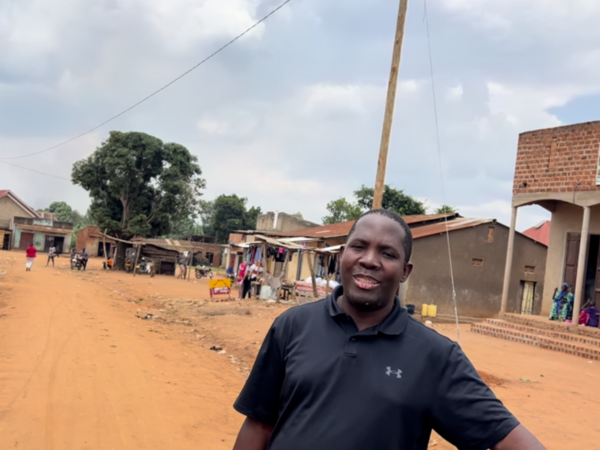
KAKUBANSIRI, A SMALL village in the Gomba district of Uganda, lived without electricity since its inception. Despite some progress, national electricity access in Uganda remains relatively low, with estimates ranging from 22% and 60% in urban areas.
Fr. Raphael Ddamba is a priest in the Archdiocese of Kampala, Uganda. He studied for the priesthood at St. John’s Seminary in Camarillo. Between 2016 and 2021, he served as chaplain at St. Jude Hospital in Fullerton, and from there he was assigned to his home diocese Kampala to establish a new parish, St. Joseph the Worker Jjanya, in the Mpigi district. Currently, he is assigned as a college chaplain for Kyambogo public University in Kampala.
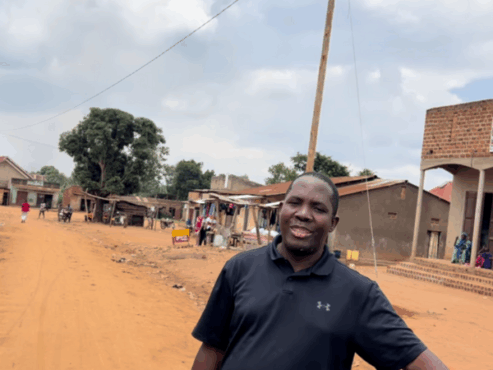
ST. JULIANA FALCONERI PARISH IN FULLERTON SUPPORTED A LIFE-CHANGING PROJECT THAT BROUGHT ELECTRICITY TO A SMALL VILLAGE Y IN UGANDA. PHOTO COURTESY OF FR. RAPHAEL DDAMBA
Fr. Raphael is a sign of hope and innovation for his people, and not only at his primary assignments as university chaplain and parish priest. Indeed, his ministry spans beyond the walls of the university and parish communities. In 2022 he established the St. Isidore Next Generation Foundation, a non-profit incorporated in California (stisidorenextgeneration.org). The main objective is to uplift the standards of his community by ensuring basic services including access to clean water and electricity, as well as empowering the young generation through education and training them with life sustaining skills.
Last summer while visiting St. Juliana, Fr. Michael Pontarelli, OSM, St. Juliana’s pastor, asked if there was some way that the Fullerton parish could help his people in Uganda. Without skipping a beat Fr. Raphael responded: “Yes, your parish could help by bringing electricity to a small village of over 1,000 households about four kilometers away that is without electricity.”
Can you imagine living without electric power in the year 2024?
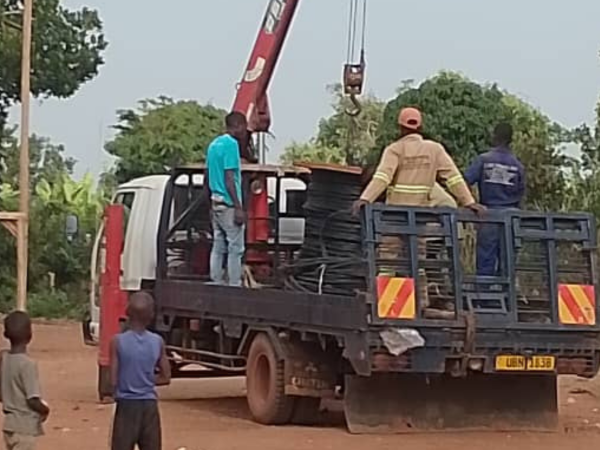
Permission for an extraordinary second collection at St. Juliana was asked for and granted. Fr. Raphael preached a powerful homily explaining the community’s need at each of the five Sunday Masses. The second collection was taken, the funds were sent and the project had begun. The first step, a thorough mapping of the area, began on Sept. 3, 2024. This was essential to assess the village’s infrastructural needs, the terrain and the distribution of power to the households. The mapping identified the most efficient routes for the laying of electrical poles and cables, ensuring that the power would reach as many of the homes, school and businesses as possible. Included in this first phase was planning for future electric power to accommodate the community’s future growth.
Once the mapping was completed, the work moved swiftly. Electric poles were erected, transformers installed and cables were laid. By the end of September 2024, the village of Kakubansiri, Uganda, experienced something they had only dreamed of –reliable electricity around-the-clock.
This is life-changing for the families and small businesses in this community. Previously, they relied on kerosene lamps which are both dangerous and expensive – but the only accessible source of fuel at the time. Children can now study and families can engage in activities well into the night. Electricity is also a promise for economic growth. Health centers can operate essential equipment. Retail shops and salons have since opened. The newly found power enables artisans to use electric tools to increase their productivity. Farming is also made easier, because of electricity access, local farmers implement irrigation, run milling machines for animal and poultry feeds and thus increase their productivity.
Establishing electricity in Kakubansiri is more than just a project; when communities work together, it is a sign of hope. What started as a casual conversation while two priests were sharing Sunday pasta became a vision. The completed project turned into a life-changing reality for people in a village more than 8,500 miles from Fullerton. From darkness to light! The village is now on a path to progress, illuminated by the power of compassion, collaboration, generosity and the dream of a couple of priests sharing a meal.
The project expanded to bring electricity to a grammar school that existed without a convenance we take for granted as being universal. Children and their teachers now study with electricity.
Can you imagine a grammar school without electricity? The St. Juliana community couldn’t either. They easily said: “Let there be light!”