

TO PARAPHRASE THE Italian monk St. Benedict, Lent is the time when we make up for our negligence the rest of the year.
Of course, good Catholics should be fervent practitioners of their faith daily. But the 40-day Lenten season that begins on Ash Wednesday (March 5) and culminates on Good Thursday (April 17) ahead of Easter Sunday (April 20) is a great reminder, priests say, to renew our focus on God.
“Lent teaches us about the Christian life in general — how we should live the rest of our lives,” says Fr. Ian Gaston, parochial vicar of Christ Cathedral.
THE NUMBER 40
The number 40 is significant in the Bible, notes Fr. Christopher Smith, rector emeritus of Christ Cathedral.
“The great flood of Noah’s time was 40 days and 40 nights, a time for those in the ark to prepare to begin again in living good lives,” he explained. “The sign of God’s saving grace was the rainbow at the end of the flood.
“The number also calls to mind the 40 years Moses and the Israelites spent in the dessert preparing to enter the promised land.
“And Jesus spent 40 days in the desert preparing for his public ministry.
“The 40 days of Lent are about preparing to celebrate the central events of our salvation: the passion, death and resurrection of Jesus.”
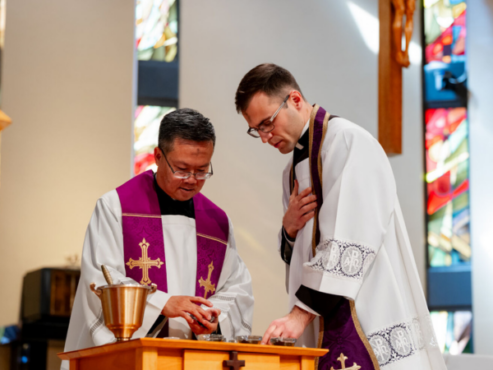
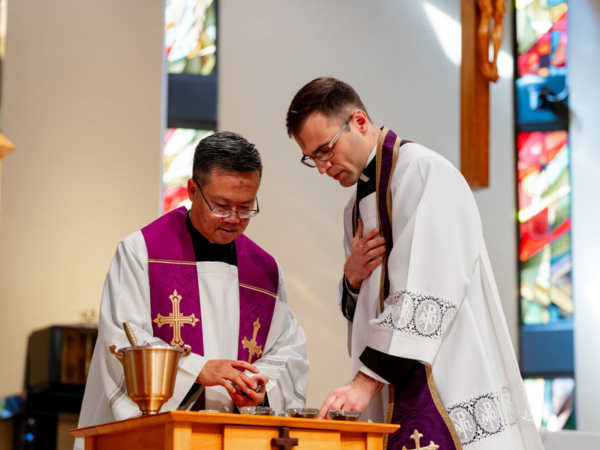
FR. BINH NGUYEN, PASTOR OF ST. IRENAEUS IN CYPRESS, AND FR. IAN GASTON BLESS THE ASHES BEFORE ADMINISTERING THEM DURING ST. IRENAEUS CATHOLIC CHURCH’S 2024 ASH WEDNESDAY MASS. PHOTO BY YUAN WANG/DIOCESE OF ORANGE
NOT IN THE BIBLE
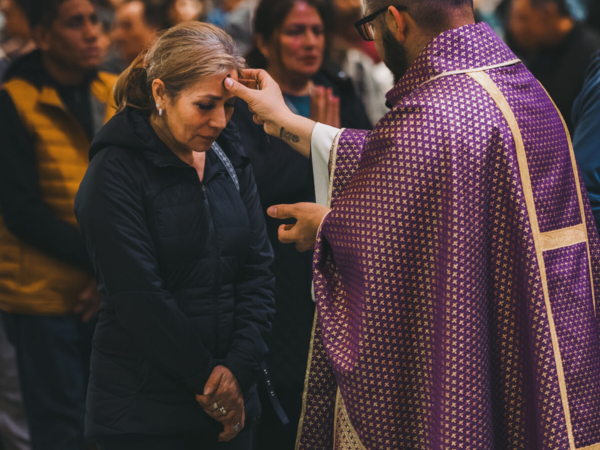
Ash Wednesday, when the faithful get their foreheads blessed with ashes at Mass or a prayer service, isn’t mentioned in the Bible (neither is Lent) but ashes as a symbol of repentance are. Notable passages include Daniel 9:3 (“I turned to the Lord God, to seek help, in prayer and petition, with fasting, sackcloth and ashes”) and Jonah 3: 6-8, in which the king of Nineveh, responding to Jonah’s warning, rose from his throne, laid aside his robe, covered him self with sackcloth, and sat in ashes and declared that man and beast alike “must turn from their evil way and from the violence of their hands.”
Catholics have been receiving ashes on Ash Wednesday since the time of St. Gregory the Great (bishop of Rome from 590 to 604 AD), notes the Dynamic Catholic Institute. In 1091, Pope Urban II encouraged the entire Church to use ashes on Ash Wenesday, according to the website dynamiccatholic.com. But in the U.S., the practice of receiving ashes on the forehead didn’t receive mainstream popularity until the early 1970s.
Although not a holy day of obligation, Ash Wednesday is a day of abstinence (no meat) and fasting (only one full meal) for Catholics, as are Fridays during Lent. Those from the ages 18-59 are required to fast (on Ash Wednesday and Good Friday); those 14 and over are required to abstain from meat on Ash Wednesday and all Fridays during Lent.
KEEPING IT QUIET
Despite the visible sign of ashes on foreheads, Catholics should heed the declaration of the Gospel reading (Matthew 6:1-6, 16-18) on Ash Wednesday:
practice one’s faith quietly, Fr. Ian said. Specifically, that Gospel advises all to engage in three things: fasting, praying and almsgiving (charity or philanthropy).
“Don’t do these three things for human praise,” Fr. Ian said, “but for the Father. Keep it secret and you will be rewarded by the Father, and not men.”
More broadly, it’s important during Lent to believe in the message that is conveyed by the life of Jesus, Fr. Ian added.

BISHOP TIMOTHY FREYER POSES WITH CLERGY AND UC IRVINE STUDENTS FOLLOWING A 2023 ASH WEDNESDAY MASS. PHOTO BY IAN TRAN/DIOCESE OF ORANGE
“The beginning of Lent is a good reminder for us that the Gospels teach us that we were made for a relationship with God, that this relationship has been broken by the devil, but that Jesus Christ has restored us to God and that He wants to make us entirely new,” he said.
“He wants to transform our lives, and Jesus is offering us the chance to be transformed through a deep relationship with Him. And so, Lent is about repenting and responding to that call to be transformed by letting Jesus in our lives.
“As we receive our ashes, we should be making an interior commitment to live in that relationship so that He can do that. Because if we don’t respond, it doesn’t work.”
AN INVITATION
St. John the Baptist is noted for saying “He must increase, but I must decrease” (John 3:30), and this is the spiritual program that we are invited to embrace during the season of Lent.
“Lent should not be 40 days of irritability or misery because we are fasting and giving up stuff, said Fr. Damien Giap, rector of St. John the Baptist Catholic School in Costa Mesa. “Rather, it should be days of joy because we are foregoing our attachments to the things of this world and turning back to God. It is a time of growing deeper in our faith through prayer and spiritual reading, what we call Lectio Divina in Latin. Such spiritual activities will result in a profound joy that the fleeting pleasures of this earthly life cannot offer.”
Fr. Damien added, “We should take off the old Adam which is rooted in pride, egoism and vanity and put the new Christ, Who is the source of humility, self-sacrifice and perfect love.”
St. John the Baptist is the “voice of one calling in the wilderness, ‘Prepare the way for the Lord, make straight paths for him.’ ” (Mark 1:3), this is conversion and repentance, to turn away from sin or that which will do us spiritual harm and to turn back towards Christ.
“This is our spiritual program as we embark upon Lent, to live the asceticism of joy as Christ is increased in us and we decrease,” said Fr. Damien.