
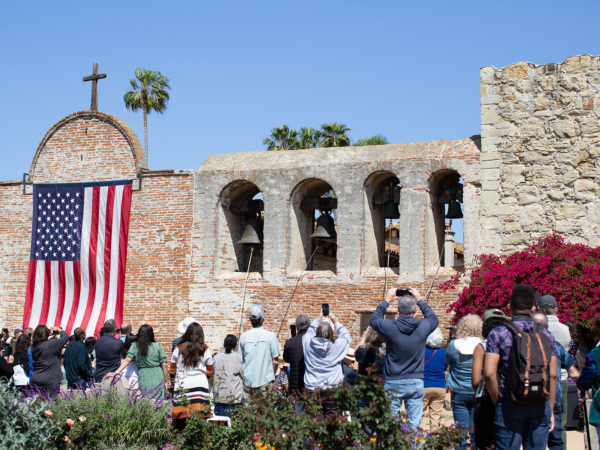
WHILE THE NATION gears up for 250th semi quincentennial celebrations of the 1776 founding of the United States, Orange County has its own 1776 commemoration lined up.
On Nov. 1, Mission San Juan Capistrano officially celebrates its birthday, with a crowded calendar of events.
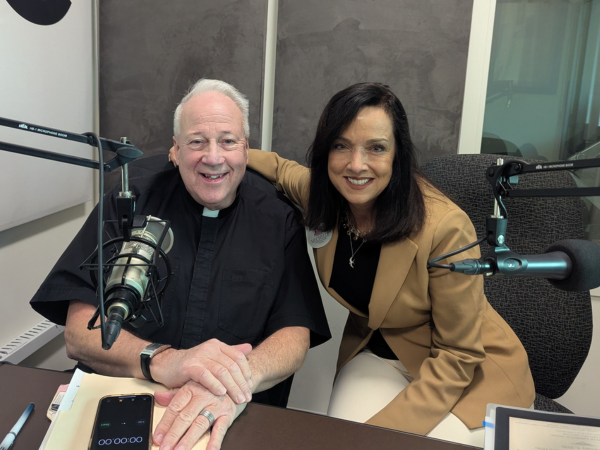
To offer an overview of the Mission’s history as well as a preview of what’s on tap, Mechelle Lawrence Adams, who has served as executive director for 23 years, recently met with Fr. Christopher Smith, Rector Emeritus of Christ Cathedral, on his “Cathedral Square” radio show.
MECHELLE LAWRENCE ADAMS, EXECUTIVE DIRECTOR OF MISSION SAN JUAN CAPISTRANO, RECENTLY MET WITH FR. CHRISTOPHER SMITH, RECTOR EMERITUS OF CHRIST CATHEDRAL, ON HIS “CATHEDRAL SQUARE” RADIO SHOW TO DISCUSS THE MISSION’S 250TH BIRTHDAY. PHOTO BY JIM GOVERNALE
The celebration began last October and is only ramping up.
“From September to November it’s intense,” Adams said.
Events include a yearlong “Artifact of the Month” program across the city, including the historic 1865 Lincoln cocument (signed by the president shortly before his death, returning ownership of the Mission to the Catholic Church), a 19th-century confessional booth, as well as rare art, books and other items. There will also be speakers, concerts and shows with award-winning performers, a food and wine festival, a spectacular uplighting ceremony, special Masses and, yes, birthday cupcakes.
It has already played host to a filming of the documentary “Acjachemen Nation 2025 Pow Wow,” about the area’s inhabitants when missionaries arrived.
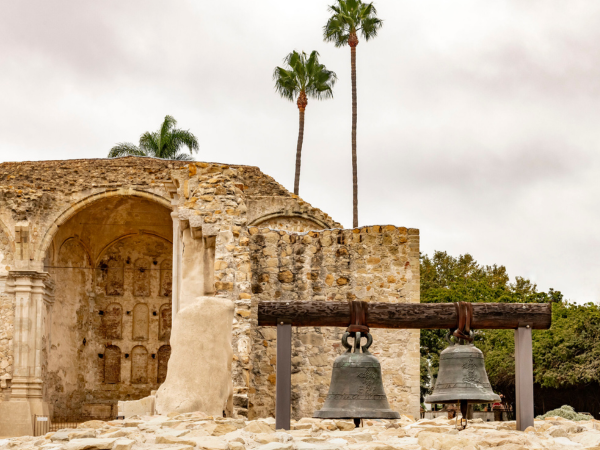
Arguably the most famous and picturesque of the California missions, it features the remaining ruins from its Great Stone Church to the surviving Serra Chapel, a profusion of flowers (and, of course, the swallows) the “Jewel of the Missions” welcomes 300,000 to 500,000 visitors annually.
Not only is the Mission a destination, but it is also internationally renowned, with tours offered in six languages, most recently adding Mandarin. Mission San Juan Capistrano is one of two California missions that celebrates 250th anniversaries this year, along with Mission San Francisco de Asís or Mission Dolores in San Francisco.
Overseeing it all, from historic preservation to marketing, is Adams.
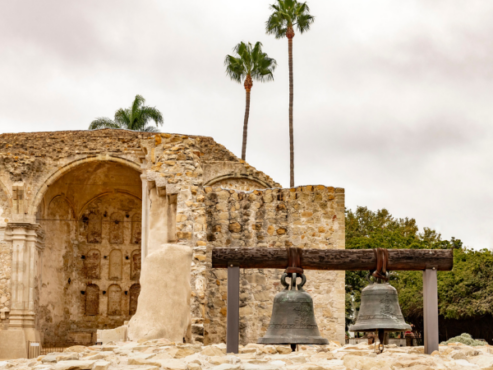
THE RUINS FROM THE GREAT STONE CHURCH, MISSION SAN JUAN CAPISTRANO. PHOTO BY JOSHUA SUDOCK/DIOCESE OF ORANGE
“Taking care of a ‘jewel’ is something we can all be proud of,” Adams said of her team, the Diocese of Orange and community partners.
The Nov. 1, 1776, Mass celebrated by St. Junípero Serra marked the re-founding of the mission, which had been abandoned a year earlier after priests and troops were withdrawn in the wake of violence to the south in San Diego.
Today’s jewel of a mission, with its spectacular display of flowers and ornate gardens, is unlike the original, which was a working enterprise of Catholic clerics, soldiers and laborers from the Acjachemen people.
However, it remains one of the better and more authentically preserved of the missions, from the ruins of the large chapel that collapsed in 1812, to the surviving Serra Chapel, the oldest standing building in California dating to 1782, and other expertly restored and renovated buildings from the era.
Adams, who is devoted to the highest degrees of historical preservation, said, “We really lean into the National Trust for Historic Preservation standards,” Adams jokingly refers to refurbishment as “Botox for the buildings.”
Attention to detail goes all the way to watering the gardens, which was changed, Adams said, when it was learned that moisture was seeping in through a de- grading original adobe.
A MOVING HISTORY
Adams said the history of the Mission is one of change —from a working farm, including the state’s original vineyard, and religious center to Spanish rule and secularization, to U.S. ownership and eventually its return to the Church.
In their way, Adams said the missions are like “a chain-link necklace of geopolitical change.”
When Adams took over, it was as a non-Catholic (she later converted to Catholicism) who could see “how the Mission was perceived” by the general public. Despite the changes, she said of the Mission, “at heart it was always Catholic.”
Even centuries later, Fr. Christopher said, “it’s amazing to see Fr. Serra’s imprint.”
For all the Mission’s historic significance, it was a piece of pop culture that brought it back to prominence.
In the 1920s Fr. Robert O’Sullivan began celebrating the small migratory birds that traveled to the Mission in the spring to nest in church eaves. In 1940 the Leon René song, “When the Swallows Come Back to Capistrano,” was recorded by the Ink Spots as well as Glenn Miller and became a smash hit. By 1954 a children’s celebration grew into a city-wide parade and a tradition was born.
“Because of that song,” Adam said, “we were ushered in as a destination.”
Although the number of “avian ambassadors,” as Adams calls the cliff swallows, has diminished due to climate change, urbanization, shifts in migratory patterns and parasites, “Swallows Day” remains hugely popular.
Despite the decline in bird population, “the first question that’s always asked,” by little children is the location of the swallows.
The Mission even hired a bird expert to study the swallows and suggest ways to revive the population.
Going forward beyond year 250, Adams said Mission San Juan Capistrano will continue as “a living organism,” with its school, regular Masses, tourists and as a wedding and entertainment venue.
“For 250, it’s robust,” Adams said.
A list of upcoming events is available at sjc250.org