
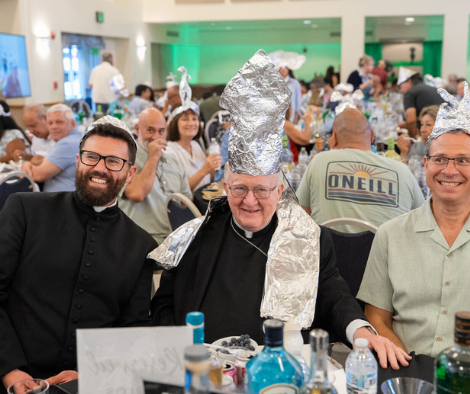
A SYMPOSIUM HOSTED BY Our Lady of Guadalupe parish in La Habra examined the possible existence of extraterrestrial intelligence in the universe, and if such alternate forms of intelligence do exist, how should these nonhuman life forms impact the Catholic faith?
Titled “Theological Implications of Alien Life,” the Aug. 30 event was the first of three symposiums hosted by the parish.
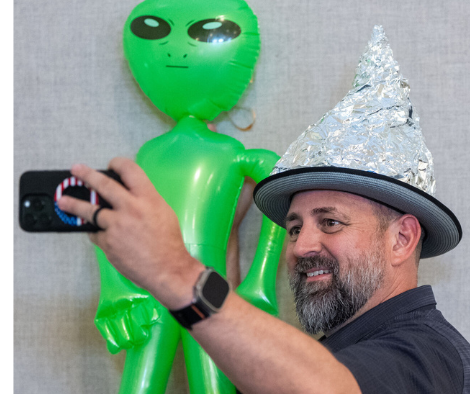
SEAN HOLMAN TAKES A SELFIE DURING OUR LADY OF GUADALUPE (LA HABRA) PARISH’S “THEOLOGICAL IMPLICATIONS OF ALIEN LIFE” EVENT. PHOTOS BY SCOTT SMELTZER/DIOCESE OF ORANGE
The symposium featured individual talks from three expert speakers, followed by a panel discussion and then a question-and-answer segment with the audience.
“This is a neat question of things that are perhaps a little strange and numinous to show that the Catholic Church isn’t afraid of the weird,” said Fr. William Goldin, pastor of Our Lady of Guadalupe. “We are happy to talk about anything that is good, true or even strange.”
Bishop Kevin Vann was in attendance and delivered a blessing before the symposium got underway.
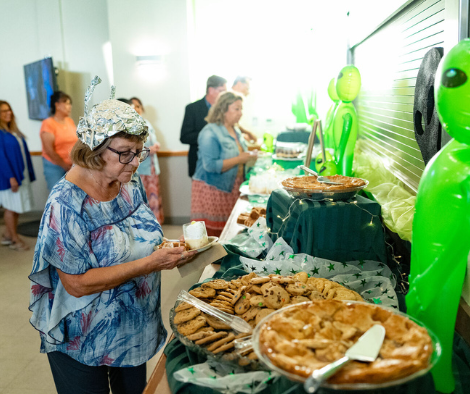
Along with the sincere discussions on the topic, a light-hearted portion of the symposium was a tinfoil hat competition, where guests tapped into their creativity to craft hats from tinfoil supplied at each table. Guests could also play the role of bartenders and mix alien-themed cocktails, using supplies provided at each table.
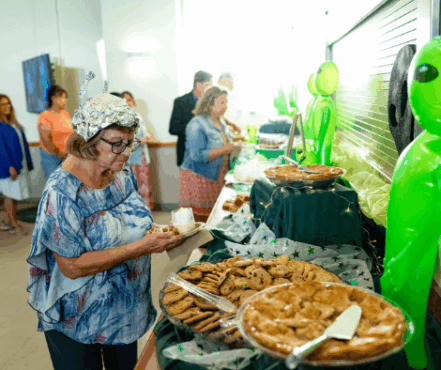
ATTENDEES OF THE AUG. 30 EVENT ALSO ENJOYED ALIEN-THEMED TREATS AND DRINKS.
The keynote speaker was Dr. Paul Thigpen, a theologian and author of more than 60 books.
Also speaking was Dr. Tikhon Pino, an Orthodox theologian and author whose work explores many different aspects of Eastern Orthodox theology. Known for his bestselling books, Pino served as a public voice on faith, history and national identity, blending theological perspectives with artistic storytelling.
The final speaker was Fr. Thomas Davenport, O.P., a Dominican priest and Stanford-trained physicist whose ministry connects faith and science.
Throughout his talk, Thigpen referenced his book, “Extraterrestrial Intelligence and the Catholic Faith: Are We Alone in the Universe with God and Angels?”
He also cited and paraphrased the words of St. Thomas Aquinas, who said one of the most noble and wondrous questions about nature is whether there is one world or many. And by that, he meant multiple inhabited worlds. Careful consideration of the question of extraterrestrial intelligence in the light of Christian faith can enrich our understanding of God, His redemption plan, the universe and ourselves, he said.
“The possibility that extraterrestrial intelligence exists is no threat to the Catholic faith or wider Christian faith,” Thigpen said. “We can remain faithful to the Church’s magisterial teaching of accommodating, that is, making room for, that possibility.”
Based on his comments, Pino appears to have a more cautious view on the topic.
The author and scholar, who holds degrees from the Catholic University of America, Holy Cross Greek Orthodox School of Theology, and a PhD from Marquette University, said that while humanity may not be physically at the center of the universe, humans are spiritually, morally and purposefully at the center.
“This I believe, ultimately, is what 2,000 years of Church tradition has taught us,” Pino said. “Not because we have failed to keep up with science. We’re always going to be behind the times.”
Pino referenced the teachings of St. Gregory of Nazianzus, a fourth-century bishop, who lived during a time when the Church was articulating its most important doctrine, particularly the doctrine of the Holy Trinity, the unity of God as Father, Son and Holy Spirit, Pino said.
“Gregory is the person who gave the Church a clear emphasis that the Holy Spirit is not just some spiritual thing or some spiritual substance or energy,” Pino said. “The Holy Spirit is God Himself, the Lord and giver of life, worshipped and glorified with the Father and the Son.”
Fr. Davenport acknowledged the possibility of such beings but stressed the need for caution and acquiring ample evidence before drawing any definitive conclusions.
“In theological reflection, for better or for worse, there is flexibility,” said Fr. Davenport, who is a faculty member at the Pontifical University of St. Thomas Aquinas in Rome. “And we can, and should, apply our best theological reflection to the world as we understand it,” “I’m going to really…hold off. Just in the sense of, there is so much fascinating and complex truth about just the nature of human perception, the nature of optical perception.”
Future symposiums at Our Lady of Guadalupe feature one titled “The Theological Implications of Ghosts and the Four Last Things,” scheduled for Nov. 1 and “The Theological Implications of Exorcisms and Deliverance,” scheduled for Jan. 31.